Key Takeaways
- Attachment styles describe patterns in how people experience closeness, support, independence, and uncertainty; they are not fixed identities.
- Early relationships can influence expectations, but later relationships, life experiences, temperament, and circumstances also matter.
- Infant attachment classifications and adult attachment dimensions are related but are not interchangeable.
- Self-awareness, clear communication, healthy boundaries, supportive relationships, and professional help when appropriate can support healthier patterns.
The Origins of Attachment Theory
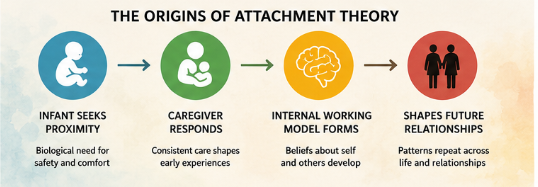
Attachment theory was developed by British psychiatrist John Bowlby during the 1950s and 1960s. Bowlby proposed that close relationships between infants and caregivers play an important role in emotional and social development.
One of his central ideas was that infants are motivated to seek proximity to a familiar caregiver when they experience fear, discomfort, or distress.
From an evolutionary perspective, staying close to a protective caregiver can provide important advantages for a dependent infant.
Bowlby also proposed that repeated interactions with caregivers contribute to what he called an internal working model — a set of expectations about relationships, support, trust, and how other people may respond to one’s needs.
These expectations can influence later relationships, but they are not permanent instructions that determine a person’s future.
Mary Ainsworth and the Strange Situation
Psychologist Mary Ainsworth extended Bowlby’s work through her research on infant-caregiver relationships.
Her best-known work included the Strange Situation procedure, developed in the 1960s and published more fully in the 1970s. The procedure examined how infants responded to brief separations from and reunions with their caregivers in a structured setting.
The research identified different patterns of attachment behaviour.
These observations contributed substantially to the development of modern attachment research and helped researchers study individual differences in how infants respond to separation, reunion, comfort, and exploration.
What Attachment Research Suggests
Attachment research suggests that early relationships can contribute to expectations about closeness, availability, comfort, and trust.
At the same time, development is influenced by many factors.
Temperament, family environment, later friendships, romantic relationships, social experiences, culture, stressful events, and personal development can all influence how people relate to others over time.
For this reason, attachment theory is better understood as a framework for understanding relationship patterns rather than as a system that permanently assigns a person to one category.
In adult attachment research, anxiety and avoidance are often measured as continuous dimensions rather than fixed boxes. A person may show different tendencies across relationships, and a label should never be treated as a complete description of someone. Research comparing categorical and dimensional models supports this more nuanced approach.
Why Early Relationships Matter
Early experiences can provide important relational learning.
A child who regularly experiences responsive care may develop expectations that support can be available when needed.
A child who experiences inconsistent, distant, or frightening interactions may develop different expectations.
However, individual children respond differently to similar environments, and later experiences can modify earlier expectations.
The most useful lesson is therefore not that childhood determines adult relationships.
It is that early relationships can form an important part of the foundation on which later relational experiences build.
Attachment patterns can continue to develop throughout life.
Secure Attachment: A Pattern of Comfortable Connection
Secure attachment describes a pattern in which a person generally feels able to seek closeness and support while also maintaining an appropriate sense of independence.
In infancy, secure attachment is associated with caregiving that is responsive and reasonably consistent. This does not require perfect parenting.
Caregivers inevitably misunderstand children, become unavailable at times, or respond imperfectly. What matters is the broader pattern of care and the opportunity for repair after difficult interactions.
Secure Attachment in Childhood
Children with more secure attachment patterns tend to use familiar caregivers as a source of comfort while also feeling able to explore their environment.
When distressed, they may seek proximity or reassurance and can often return to exploration after receiving appropriate support.
These patterns are influenced by caregiving, but children’s temperament and wider environment also contribute to development.
Secure Attachment in Adult Relationships
In adult relationships, secure attachment is often associated with greater comfort with intimacy and autonomy.
A securely attached person may be more comfortable expressing needs, receiving support, communicating openly, and managing periods of disagreement without immediately assuming that the relationship is ending.
This does not mean that securely attached people never feel jealous, insecure, angry, or afraid.
Everyone can experience difficult emotions.
The difference is often found in how those emotions are understood and managed within the relationship.
What Secure Relationships Can Look Like
A secure relational pattern may include:
– communicating needs directly
– accepting appropriate emotional closeness
– respecting personal boundaries
– giving and receiving support
– tolerating reasonable periods of disagreement or distance
– repairing conflict rather than avoiding it indefinitely
These are tendencies, not requirements that every securely attached person will display all the time.
Can Secure Attachment Develop Later?
Yes.
Early attachment experiences can influence later expectations, but adult relationships are not determined entirely by childhood.
Supportive friendships, healthy romantic relationships, life experiences, reflection, and other forms of personal development can contribute to changes in how people relate to others.
This is one reason attachment should be viewed as a pattern that can develop and change rather than as a permanent label.
A Balanced Perspective
Secure attachment is associated with healthy relationship functioning, but it does not guarantee a perfect relationship or protect someone from every emotional difficulty.
Likewise, experiencing some insecure attachment characteristics does not mean that a person cannot have loving, stable, and satisfying relationships.
Attachment theory is most useful when it helps people understand patterns without turning those patterns into fixed identities.
https://jmmindmint.com/how-to-be-a-good-listener-mastering-the-art-of-active-listening/
Anxious Attachment: A Pattern of Heightened Relationship Uncertainty
Anxious attachment describes a pattern in which a person may become especially sensitive to signs of distance, rejection, or changes in closeness within important relationships.
Attachment researchers have linked anxious patterns with concerns about whether support and connection will remain available. However, these patterns should not be explained only through childhood experiences. Personality, current relationship experiences, stress, previous relationships, and social environment can also influence how a person responds to closeness and uncertainty.
Anxious Attachment in Childhood
In childhood, anxious attachment patterns can be associated with uncertainty about how consistently comfort or support will be available.
A child may seek reassurance or remain especially attentive to a caregiver’s availability.
This does not mean that every child experiencing inconsistent care develops an anxious attachment pattern. Children differ in temperament, coping, and sensitivity, and development is influenced by many factors.
Anxious Attachment in Adult Relationships
In adult relationships, anxious attachment tendencies may appear as:
– strong sensitivity to changes in communication or closeness
– frequent concern about being rejected or abandoned
– a desire for reassurance when the relationship feels uncertain
– difficulty feeling comfortable with prolonged periods of distance
– increased attention to a partner’s words, behaviour, or responsiveness
These behaviours exist on a spectrum. Experiencing some of them does not automatically mean that someone has an anxious attachment style.
The Reassurance Cycle
Sometimes relationship uncertainty can create a cycle.
A person may notice a delayed message or change in behaviour, interpret it as possible rejection, feel anxious, and seek reassurance. Temporary reassurance may reduce the anxiety, but uncertainty can return later.
Recognizing this cycle can be more useful than blaming either partner.
The goal is not to suppress legitimate concerns. It is to distinguish between evidence about the current relationship and assumptions created by fear or uncertainty.
For a related look at patterns that can unintentionally interfere with relationships, read The Psychology of Self-Sabotage: Why We Undermine Our Goals.
How to Respond More Effectively
Helpful approaches may include:
– identifying the specific trigger rather than reacting immediately
– checking facts before drawing conclusions
– communicating needs clearly instead of relying on indirect signals
– allowing reasonable space without automatically interpreting it as rejection
– developing sources of emotional support and confidence outside one relationship
Understanding how we interpret relationship signals can also improve self-awareness. For a related discussion of how attitudes shape our responses, read What Is Attitude? Meaning, the ABC Model and How Attitudes Shape Behaviour.
Attachment awareness should support self-understanding, not self-judgment.
A person with anxious attachment tendencies is not destined to have unstable relationships. With greater self-awareness, healthy communication, supportive relationships, and appropriate personal development, relationship patterns can change over time.
Avoidant Attachment: A Pattern of Strong Independence
Avoidant attachment describes a pattern in which a person may place a strong value on independence and may feel uncomfortable with intense emotional closeness or reliance on others.
Attachment research has associated avoidant patterns with experiences in which emotional needs were not consistently met or openly encouraged. However, adult attachment cannot be explained by childhood caregiving alone. Temperament, personality, later relationships, cultural expectations, and current circumstances can all influence how a person experiences closeness and independence.
Avoidant Attachment in Childhood
Children may develop different ways of responding to emotional needs depending on their experiences with caregivers and their wider environment.
Some children may learn to rely more heavily on themselves when seeking comfort does not consistently produce a helpful response.
This does not mean that emotional distance in childhood automatically produces avoidant attachment. Development is complex, and similar experiences can affect children differently.
Avoidant Attachment in Adult Relationships
In adult relationships, avoidant tendencies may appear as:
– strong preference for independence
– discomfort with emotional vulnerability
– difficulty expressing personal needs
– desire for considerable personal space
– withdrawal during highly emotional situations
– discomfort when a relationship becomes very intense
These behaviours do not necessarily mean that a person does not care about others.
Someone may value a relationship deeply while still finding emotional closeness difficult to manage.
Independence vs Emotional Avoidance
Independence itself is not unhealthy.
Maintaining personal interests, boundaries, friendships, and time alone can be part of a healthy relationship.
The difficulty can arise when independence becomes a way of consistently avoiding communication, vulnerability, or emotional connection.
A useful question is:
Am I choosing healthy space, or am I using distance to avoid something that feels emotionally difficult?
The answer may change depending on the situation.
Communication and Avoidant Patterns
When emotional conversations feel uncomfortable, a person may withdraw, delay responding, change the subject, or minimize the importance of the issue.
Recognizing this pattern can create an opportunity to respond differently.
Instead of immediately withdrawing, a person might communicate a need for space while also making clear that the relationship still matters.
For example:
> “I need some time to think, but I don’t want to avoid this conversation. Let’s talk about it later.”
Developing emotional awareness can make these conversations easier. For practical communication skills, read How to Be a Better Listener: Active Listening Skills That Build Trust and Connection.
A Balanced Perspective
Avoidant attachment should not be treated as a permanent identity.
A person can become more comfortable with vulnerability, communication, and emotional closeness through later experiences, supportive relationships, reflection, and personal development.
The goal is not to eliminate independence.
It is to build a healthier balance between autonomy and connection.
Understanding attachment patterns can help people notice when self-protection is useful and when it may be preventing the connection they genuinely value.
Disorganised Attachment: When Closeness and Safety Feel Complicated
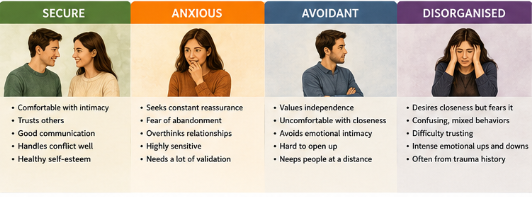
Disorganised attachment is a term used in attachment research to describe certain patterns of behaviour observed in relationships between infants and their caregivers. These patterns may involve conflicting responses to a caregiver who is both a source of comfort and, at times, a source of fear or distress.
This concept can help explain why experiences of closeness and safety may become complicated for some people. However, attachment patterns are complex, and a person’s childhood experiences alone cannot explain every difficulty they experience in adult relationships.
How Disorganised Attachment Is Understood
In infant attachment research, disorganised attachment refers to behaviour that does not form one clear, consistent strategy for seeking comfort from a caregiver in stressful situations.
Researchers have examined several factors that may contribute to these patterns, including frightening interactions, experiences of fear, and difficulties in the caregiving environment.
However, disorganised attachment should not be used to assume that abuse occurred in every case. Nor should it be treated as a diagnosis that can be established simply by observing someone’s adult relationship behaviour.
Possible Patterns in Adult Relationships
Some adults who have experienced difficult or frightening relationships may find emotional closeness complicated. Depending on their experiences and circumstances, they may:
– want emotional connection but feel uncomfortable when someone gets very close
– struggle to trust others after painful relationship experiences
– feel uncertain about whether to approach someone for support or create distance
– experience strong emotional reactions during conflict
– find it difficult to communicate their needs when they feel overwhelmed
These experiences are not exclusive to disorganised attachment, and they do not establish a person’s attachment style on their own.
Relationship behaviour can also be influenced by present circumstances, personality, stress, mental health, and the quality of the relationship itself.
Why Safety and Trust Matter
For people who have experienced frightening or unpredictable relationships, developing trust may take time.
Supportive relationships can offer opportunities to experience clearer boundaries, more consistent communication, and greater emotional safety. Progress does not always happen quickly, and nobody should be pressured to become vulnerable before they feel ready.
It is equally important to recognize that a person is not responsible for another person’s abusive or harmful behaviour.
Helpful Ways to Approach Relationship Difficulties
When relationships feel confusing or emotionally overwhelming, it may help to:
– notice what situations trigger feelings of fear, uncertainty, or withdrawal
– communicate boundaries and personal needs as clearly as possible
– build trust gradually instead of feeling pressured to trust immediately
– seek support from a qualified mental health professional when past experiences continue to cause significant distress
– recognize relationships that are consistently unsafe and seek appropriate support when needed
Understanding emotions can help people identify their reactions and communicate more clearly. Read our guide to active listening and better communication.
A Balanced Perspective
Disorganised attachment is a research concept, not a permanent identity or a prediction of someone’s future.
Difficult early experiences may influence later relationships, but people are not defined entirely by their past. Support, safer relationships, personal reflection, and appropriate professional help may contribute to healthier ways of relating over time.
The Anxious-Avoidant Trap: Understanding the Pursue-Withdraw Cycle
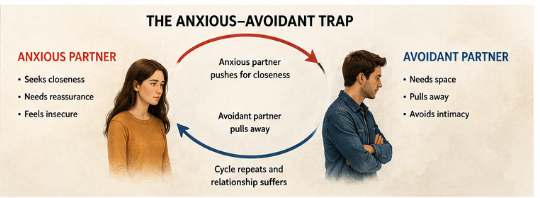
Some relationships develop a repeating pattern in which one person seeks more reassurance or closeness while the other responds by creating distance. This is often described as a pursue-withdraw cycle.
Attachment theory can help explain some of these interactions, particularly when one partner experiences relationship uncertainty intensely and the other feels overwhelmed by emotional demands. However, this pattern does not occur in every relationship between people with different attachment tendencies.
How the Cycle Can Develop
Imagine one partner becomes worried when messages go unanswered or conversations feel less affectionate than usual. They may seek reassurance, ask repeated questions, or try harder to restore closeness.
The other partner may experience these efforts as pressure and withdraw to regain a sense of space. That withdrawal can increase the first person’s uncertainty, leading them to seek even more reassurance.
Over time, both people may feel misunderstood.
One person may feel rejected or ignored, while the other may feel overwhelmed or unable to meet expectations. Each person’s response can unintentionally intensify the other’s distress.
Why Understanding Matters
The cycle is not necessarily evidence that either person is uncaring or deliberately trying to hurt the other.
It can reflect different ways of responding to uncertainty, emotional pressure, conflict, and the need for connection. Attachment tendencies may play a role, but present relationship circumstances and communication habits matter too.
It is also important not to use attachment labels to excuse harmful behaviour. Repeated disrespect, intimidation, manipulation, or abuse should not be dismissed as an attachment-style problem.
Ways to Interrupt the Cycle
1. Recognize the pattern. Notice when one person pursues a conversation while the other repeatedly withdraws. Focus on the interaction rather than assigning blame.
2. Communicate needs clearly. Instead of making accusations, explain what you are feeling and what would help. For example: “When we stop talking during a disagreement, I feel uncertain. Can we agree on a time to continue the conversation?”
3. Make space without abandoning the conversation. A person who needs time to think can explain that need and agree on a reasonable time to reconnect.
4. Check interpretations. A delayed response does not always mean rejection, and a request for reassurance does not always mean an attempt to control someone. Look at the wider context before reaching conclusions.
5. Respect boundaries. Both partners deserve emotional consideration, personal space, and freedom from pressure or intimidation.
Recognizing how people interpret relationship signals can be helpful. For more on how attitudes shape our responses, read What Is Attitude? Meaning, the ABC Model and How Attitudes Shape Behaviour.
When More Support May Help
If the same conflicts continue despite sincere efforts to communicate, a qualified relationship counsellor or mental health professional may help both partners understand the pattern and develop healthier ways to respond.
Both partners must be willing to participate freely. Where there is abuse, coercion, or fear for personal safety, individual support and safety planning should take priority over trying to repair the relationship together.
A Balanced Perspective
The anxious-avoidant trap is one possible relationship pattern, not a rule that determines who people will choose or whether a relationship will succeed.
People can learn to communicate more clearly, respond thoughtfully to uncertainty, and balance closeness with independence. Understanding the cycle is a starting point—not a guarantee of a particular outcome. Understanding how our minds interpret situations can also improve relationship awareness. How we interpret a partner’s words and actions can influence how we respond. Read Understanding Perception: How We Interpret the World Around Us
https://jmmindmint.com/what-is-attitude/.htmlfor a related explanation.
Attachment Styles Across the Lifespan
Attachment patterns can show some continuity over time, but they are not necessarily fixed. People’s expectations about trust, closeness, independence, and emotional support may change as they experience new relationships and different stages of life.
Understanding attachment across the lifespan helps explain why someone may respond differently to relationships at different times. It also reminds us that early experiences are only one part of a person’s development.
Attachment During Adolescence
Adolescence often brings changes in independence, friendships, family relationships, and romantic interests.
Teenagers may begin relying more on peers for emotional support while still needing guidance and security from trusted adults. Experiences during this stage can influence how young people communicate, manage disagreements, and respond to closeness.
However, there is no single attachment pattern that determines how every teenager will develop. Individual temperament, family circumstances, social environment, and personal experiences also matter.
Attachment in Adult Relationships
Romantic relationships and close friendships can bring attachment-related expectations into focus.
For example, one person may seek reassurance when communication changes, while another may prefer time alone before discussing a disagreement. These different responses can sometimes create misunderstandings.
Recognizing such tendencies can help people communicate their needs without assuming that every disagreement reflects rejection, a lack of love, or an incompatible relationship.
Emotional awareness can support this process. Read How to Be a Better Listener to explore how listening and communication can improve relationships.
Attachment in Long-Term Relationships
Over time, people may develop a better understanding of each other’s needs, boundaries, and communication styles.
A relationship in which both people respond with respect and consistency may create opportunities to build trust. Difficult relationships, unresolved conflict, or major life stressors may also influence how secure or uncertain someone feels.
No relationship is perfectly secure at every moment. Stress, illness, major life changes, and disagreements can affect even people who generally feel comfortable with intimacy.
What matters is how people respond to difficulties, communicate their needs, respect boundaries, and work toward resolving problems.
Can Attachment Patterns Differ Between Relationships?
Yes. Someone may feel relatively comfortable depending on a close friend but experience greater uncertainty in a romantic relationship. Another person may feel secure with a partner but uncomfortable asking colleagues or family members for support.
Such differences are possible because relationships have different histories, expectations, and circumstances.
Attachment categories should therefore be used as tools for reflection, not as permanent labels that explain every interaction.
A Balanced Perspective
Attachment patterns may influence how people experience relationships, but they do not determine every choice or outcome.
People continue to learn from friendships, partnerships, family experiences, setbacks, and personal reflection throughout life. Understanding these patterns can encourage greater self-awareness while leaving room for individual differences and change.
Can Attachment Styles Change?
Yes. Attachment patterns can change over time, although change is not always immediate or predictable.
Early relationships may influence how people experience trust, closeness, and emotional support. However, later friendships, romantic relationships, life experiences, personal reflection, and professional support can also influence how people approach relationships.
An attachment style is not a permanent label or a fixed prediction of someone’s future.
How Attachment Patterns May Change
Change can begin when people recognize recurring relationship responses and start exploring what triggers them.
For example, a person who frequently worries about rejection may learn to pause before interpreting an unanswered message as evidence that a relationship is failing. Someone who tends to withdraw during emotional conversations may gradually practise communicating their need for space without abandoning the discussion.
These changes often involve repeated practice rather than one sudden realization.
The Role of Supportive Relationships
Relationships that involve respect, consistency, honest communication, and appropriate boundaries may provide opportunities to develop greater trust.
Supportive relationships do not require people to agree on everything or avoid conflict. Instead, they allow disagreements to be addressed without humiliation, intimidation, or repeated disregard for one another’s needs.
However, one partner cannot be expected to change another person’s attachment pattern through patience alone. Each person remains responsible for their own behaviour, and both people deserve healthy boundaries.
Can Therapy Help?
A qualified mental health professional may help someone explore relationship patterns, understand emotional triggers, and develop more helpful ways of responding.
The most suitable approach depends on the person’s circumstances, needs, and goals. Therapy does not guarantee a particular attachment style or a specific relationship outcome, but it may provide structured support for working through ongoing difficulties.
People experiencing persistent distress or repeated relationship problems may benefit from seeking professional guidance.
Practical Steps That Support Growth
-
Notice recurring responses to closeness, distance, and conflict.
-
Separate observable facts from assumptions about another person’s intentions.
-
Practise expressing emotional needs clearly and respectfully.
-
Learn to balance personal independence with appropriate support from others.
-
Reflect on relationship patterns without blaming yourself for every difficulty.
-
Seek professional support when these patterns cause significant distress.
Personal growth also involves understanding what motivates our choices and actions. Explore Why We Procrastinate Even When We Want to Stop for a related perspective.
Attachment Is a Pattern, not a Life Sentence
Understanding attachment can help people recognize patterns, but awareness alone does not automatically change them.
Progress may be gradual, and people may respond differently in different relationships or under stress. Setbacks do not necessarily mean that progress has been lost.
The goal is not to force yourself into a particular attachment category. It is to build healthier ways of communicating, managing emotions, setting boundaries, and creating relationships based on mutual respect and trust.

How to Work With Your Attachment Style
Understanding attachment patterns can help you recognize how you respond to closeness, uncertainty, emotional needs, and conflict. The purpose is not to label yourself or your partner. It is to identify behaviours that may be helpful to change and develop healthier ways of relating.
There is no single approach that works for everyone. Start by noticing your own experiences and choose practical steps that respect both your needs and other people’s boundaries.
For Those Who Recognize Anxious Attachment Tendencies
If you often worry about rejection or feel uncertain when someone becomes distant, consider these approaches:
-
Pause before reacting. When a message goes unanswered or someone’s mood changes, distinguish what you know from what you fear might be happening.
-
Communicate directly. Explain what would help you feel connected instead of relying on repeated messages, indirect hints, or assumptions.
-
Build emotional resilience. Develop friendships, interests, routines, and sources of support beyond one relationship.
-
Check the relationship itself. Your concerns may sometimes reflect uncertainty within you, but they may also reflect genuine inconsistency or problems in the relationship.
The aim is not to stop needing reassurance. It is to communicate that need in a balanced way while also evaluating whether the relationship provides respect and reliability.
For Those Who Recognize Avoidant Attachment Tendencies
If emotional conversations or dependence on others feel uncomfortable, consider these approaches:
-
Notice the urge to withdraw. Ask yourself whether you need reasonable personal space or are avoiding a conversation that matters.
-
Explain your need for space. Let the other person know when you need time to think, and communicate when you can return to the discussion.
-
Practise small moments of openness. Sharing one feeling or concern at a time may feel more manageable than discussing everything at once.
-
Respect both independence and connection. Personal boundaries matter, but so does making room for a partner’s reasonable emotional needs.
You do not have to give up independence to develop closer relationships. The goal is to make space for emotional connection without ignoring your own comfort and boundaries.
For Anyone Working on Relationship Patterns
Whatever attachment tendencies you recognize, these practices may be useful:
-
Identify the situations that repeatedly trigger strong emotional reactions.
-
Reflect on how your actions affect other people without blaming yourself for everything that goes wrong.
-
Learn to express needs and boundaries clearly.
-
Listen to another person’s perspective without automatically assuming agreement is necessary.
-
Recognize the difference between ordinary relationship difficulties and repeated disrespect or harmful behaviour.
-
Consider speaking with a qualified mental health professional if relationship patterns cause ongoing distress or are difficult to change alone.
Sometimes people repeat behaviours that conflict with the relationships they want. Our article The Psychology of Self-Sabotage explores this broader topic.
When Professional Support May Help
If relationship difficulties lead to persistent anxiety, repeated conflict, emotional distress, or problems functioning in everyday life, professional support may help you understand what is happening and explore healthier responses.
Therapy is not a requirement for everyone who recognizes an attachment tendency, and it does not guarantee a particular outcome. Support should be appropriate to your needs and circumstances.
If you are experiencing abuse, coercion, or fear for your safety, prioritize safety and seek suitable support rather than assuming that changing your attachment pattern will solve the problem.
Give Yourself Room to Grow
Attachment awareness is a starting point, not a test you must pass.
You may respond differently in different relationships, and difficult situations can sometimes bring back familiar reactions. That does not mean change is impossible.
Focus on what you can practise: clearer communication, thoughtful responses, appropriate boundaries, emotional awareness, and relationships built on mutual respect.
Progress is not about becoming a perfect partner. It is about understanding yourself better and making choices that support healthier connections.
Frequently Asked Questions About Attachment Styles
Can you have different attachment patterns with different people?
Yes. A person may feel comfortable with emotional closeness in one relationship but experience greater uncertainty or discomfort in another. Relationship history, trust, communication, personal experiences, and current circumstances can influence these differences. Attachment styles are useful concepts for understanding patterns, not fixed labels that describe every relationship.
Is anxious attachment the same as an anxiety disorder?
No. Anxious attachment refers to patterns of responding to closeness, separation, and uncertainty in relationships. An anxiety disorder is a mental health condition that requires appropriate clinical assessment. The two may occur together, but recognizing anxious attachment tendencies does not mean that someone has an anxiety disorder.
Can therapy help change attachment patterns?
Therapy may help people explore relationship difficulties, understand emotional triggers, and practise healthier ways of communicating and responding. The type of support that is appropriate depends on the person’s circumstances and goals. Change can take time, and therapy cannot guarantee a particular attachment style or relationship outcome.
Are attachment styles inherited genetically?
Attachment patterns are influenced by relationships and environmental experiences, but development is complex. Temperament and other individual differences may also play a role. It would be inaccurate to explain attachment patterns entirely through genetics or to assume that childhood experiences alone determine a person’s adult attachment.
How can I understand my own attachment pattern?
Start by noticing how you respond to closeness, uncertainty, separation, emotional vulnerability, and conflict. Look for recurring patterns across situations rather than judging yourself by one difficult interaction.
Self-reflection can be a useful starting point, but online quizzes and informal descriptions cannot provide a clinical diagnosis. A qualified mental health professional may help you explore persistent relationship difficulties in greater depth.
Does an insecure attachment pattern mean that a relationship will fail?
No. Attachment tendencies do not determine the outcome of a relationship. Communication, mutual respect, compatibility, boundaries, life circumstances, and each person’s behaviour also matter.
Recognizing unhelpful patterns may help people make more thoughtful choices, but a healthy relationship requires effort and responsibility from both partners.
Can someone become more secure over time?
Attachment patterns can change as people gain new experiences and develop different ways of responding to relationships. Supportive relationships, reflection, improved communication, and professional help when appropriate may contribute to greater confidence and emotional security. Progress varies from person to person.
For more on recognizing and managing emotions in everyday life, read Emotional Intelligence: Why It Matters for Success, Relationships, and Mental Well-Being.
Conclusion: Understanding Our Patterns and Building Healthier Relationships
Attachment theory offers a useful way to understand how people experience closeness, trust, emotional support, independence, and uncertainty in relationships.
Early relationships may contribute to the expectations we carry into adulthood, but they do not determine every relationship or decision we make. Personality, later experiences, present circumstances, communication, and the quality of our relationships also influence how we connect with others.
Recognizing attachment tendencies can help us identify recurring patterns. We may notice that we seek reassurance when we feel uncertain, withdraw when conversations become emotionally intense, or struggle to balance independence with closeness.
These observations are not reasons to blame ourselves or others. They are opportunities to understand our responses and consider healthier alternatives.
Change does not require perfection. It may begin with expressing a need more clearly, pausing before reacting, respecting boundaries, listening with greater care, or seeking professional support when relationship difficulties become overwhelming.
It is also important to remember that healthy relationships require mutual respect. Understanding attachment should never be used to excuse manipulation, abuse, or repeated disrespect, nor should anyone feel responsible for changing another person’s behaviour alone.
For a related perspective on how emotional awareness can improve communication and relationships, explore Emotional Intelligence: Why It Matters for Success, Relationships, and Mental Well-Being.
Ultimately, attachment styles are best understood as patterns to reflect on, not permanent identities that define who we are.
Our past may influence how we connect, but it does not have to dictate how we build relationships in the future. With self-awareness, thoughtful choices, healthy boundaries, and supportive connections, we can continue learning how to relate to ourselves and others more constructively.
References
The following books and research publications provide background for this article on attachment theory and relationship patterns.
-
Bowlby, J. (1969). Attachment and Loss, Volume 1: Attachment. Basic Books.
-
Ainsworth, M. D. S., Blehar, M. C., Waters, E., & Wall, S. (1978). Patterns of Attachment: A Psychological Study of the Strange Situation. Lawrence Erlbaum Associates.
-
Hazan, C., & Shaver, P. (1987). Romantic love conceptualized as an attachment process. Journal of Personality and Social Psychology, 52(3), 511–524. https://doi.org/10.1037/0022-3514.52.3.511
-
Main, M., & Solomon, J. (1990). Procedures for identifying infants as disorganized/disoriented during the Ainsworth Strange Situation. In M. T. Greenberg, D. Cicchetti, & E. M. Cummings (Eds.), Attachment in the Preschool Years: Theory, Research, and Intervention. University of Chicago Press.
-
Johnson, S. M. (2008). Hold Me Tight: Seven Conversations for a Lifetime of Love. Little, Brown and Company.
Recent research and reviews also help explain why attachment should be understood as a pattern that can show both continuity and change:
- Waters, E., & Waters, T. E. A. (2024). Developmental change, bricolage, and how a lot of things develop: Mechanisms and changes in attachment across the lifespan. Development and Psychopathology, 36(5), 2256–2275.
- Dugan, K. A., Fraley, R. C., Gillath, O., & Deboeck, P. R. (2024). Testing the canalization hypothesis of attachment theory: Examining within-subject variation in attachment security. Journal of Personality and Social Psychology, 126(3), 511–541.
- Granqvist, P., et al. (2017). Disorganized attachment in infancy: A review of the phenomenon and its implications for clinicians and policy-makers. Attachment & Human Development.
About the Author
Jagadish Mokashi is the founder of JM MindMint, a psychology and human-behaviour platform exploring psychology, cyberpsychology, digital life, and AI ethics.
With an academic background in Psychology and professional experience in technology, he writes about the relationship between human behaviour, technology, and everyday life.
Through JM MindMint, his goal is to make psychological concepts easier to understand through practical, evidence-informed content.
Website: https://jmmindmint.com/
Written by Jagadish Mokashi
Founder, Mind Mint | Psychology • Human Behaviour • AI Ethics
jmmindmint.com/