
By Jagadish Mokashi | Mind Mint
Introduction

I Want You to Try Something Right Now
Put a timer on your phone. Open Instagram or YouTube Shorts. Start scrolling.
Don’t stop until the timer goes off.
Set it for just 15 minutes.
I am willing to bet that when the timer rings — you will not want to stop. You will feel a strange pull to keep going. Just one more reel. Just one more post. Just one more.
And when you finally put the phone down — you will feel a little empty. A little flat. Like something was just switched off.
That feeling is not random. That feeling has a name. And understanding it changed the way I think about my own phone use completely.
What Indian Researchers Found in 2025
An exploratory 2025 study published in Cureus by researchers affiliated with the Satani Research Centre in Ahmedabad examined EEG activity during social-media use. It included 100 healthy adults aged 18–45 who completed 30-minute sessions. The researchers reported changes in several EEG frequency bands during and after use. This is an interesting early finding, but a short laboratory session cannot establish that scrolling causes lasting brain changes or predict how every user will respond. The authors themselves called for further longitudinal research. Read the study.
What they found was not surprising in one sense. But seeing it measured and confirmed in a proper scientific study still hit differently.
In this experiment, the researchers reported lower alpha activity and higher beta and gamma activity during engagement, with some elevated activity continuing briefly after the session. EEG frequency bands are not simple readouts of excitement, addiction, or brain damage. These results should be interpreted as measurements from this particular sample and task, not as proof that ordinary social-media use harms the brain.
The researchers also observed that some beta and gamma activity remained elevated after participants stopped. They suggested this might reflect continued cognitive or emotional processing. The study did not show that every person remains agitated after scrolling, nor did it measure long-term sleep or mental-health outcomes.
The authors discussed this as a possible period of continued cognitive excitation. It is a proposed interpretation of EEG patterns, not a clinical diagnosis or proof of lasting overstimulation.
Some people report feeling mentally activated or unsettled after consuming emotionally intense content. The EEG study offers one possible avenue for further research, but it does not prove that scrolling is the cause of sleep problems. Content, timing, individual differences, and overall screen habits all matter.
The Brain Rot That Oxford Made Official
In December 2024, Oxford Languages selected “brain rot” as its Word of the Year. The phrase captured a cultural concern about spending too much time with low-quality or undemanding online content. It is a popular expression, not a medical or psychological diagnosis. Oxford’s announcement.
It was “brain rot.”
Oxford defined it as the supposed deterioration of a person’s mental or intellectual state as a result of overconsumption of material considered to be trivial or unchallenging — especially online content.
The choice reflects a public conversation about digital habits; it does not establish that social media has caused a measurable decline in intelligence or attention across the population.
The phrase has entered public discussion, but it should not be confused with a scientific finding about widespread cognitive decline.
Your Brain on a Slot Machine
Let me explain what is actually happening inside your brain when you scroll — because once you understand the mechanism, you cannot unsee it.
Unpredictable social feedback can make checking behaviour more rewarding. Dopamine is involved in learning about rewards and predicting what may happen next, but it is inaccurate to claim that every refresh produces a predictable dopamine “hit”. The process involves learning, expectation, attention, and social motivation.
Psychologists sometimes use variable reinforcement as an analogy for unpredictable online rewards. The comparison can be useful, but social-media engagement is not identical to gambling: the motivations, consequences, and clinical criteria differ.
Unpredictability is one reason people may check again: the next item could be interesting, funny, socially meaningful, or disappointing. This does not mean every user becomes addicted, and the slot-machine comparison is only an analogy for one part of reward learning.
An unpredictable feed can encourage a person to check again because the next item might be interesting, socially meaningful, or emotionally engaging. This is a simplified analogy for reward learning, not a literal account of a slot machine operating inside the brain.
A December 2025 UC Santa Barbara news feature discussed research into gaming disorder and the broader question of problematic media use. It did not report a 2025 brain-scan study proving that social-media addiction is neurologically identical to gambling or substance addiction. Social-media addiction is not currently a formal standalone diagnosis in major diagnostic manuals, and researchers continue to investigate problematic use. Read the UC Santa Barbara discussion.
What Heavy Scrolling Does to Young People Specifically
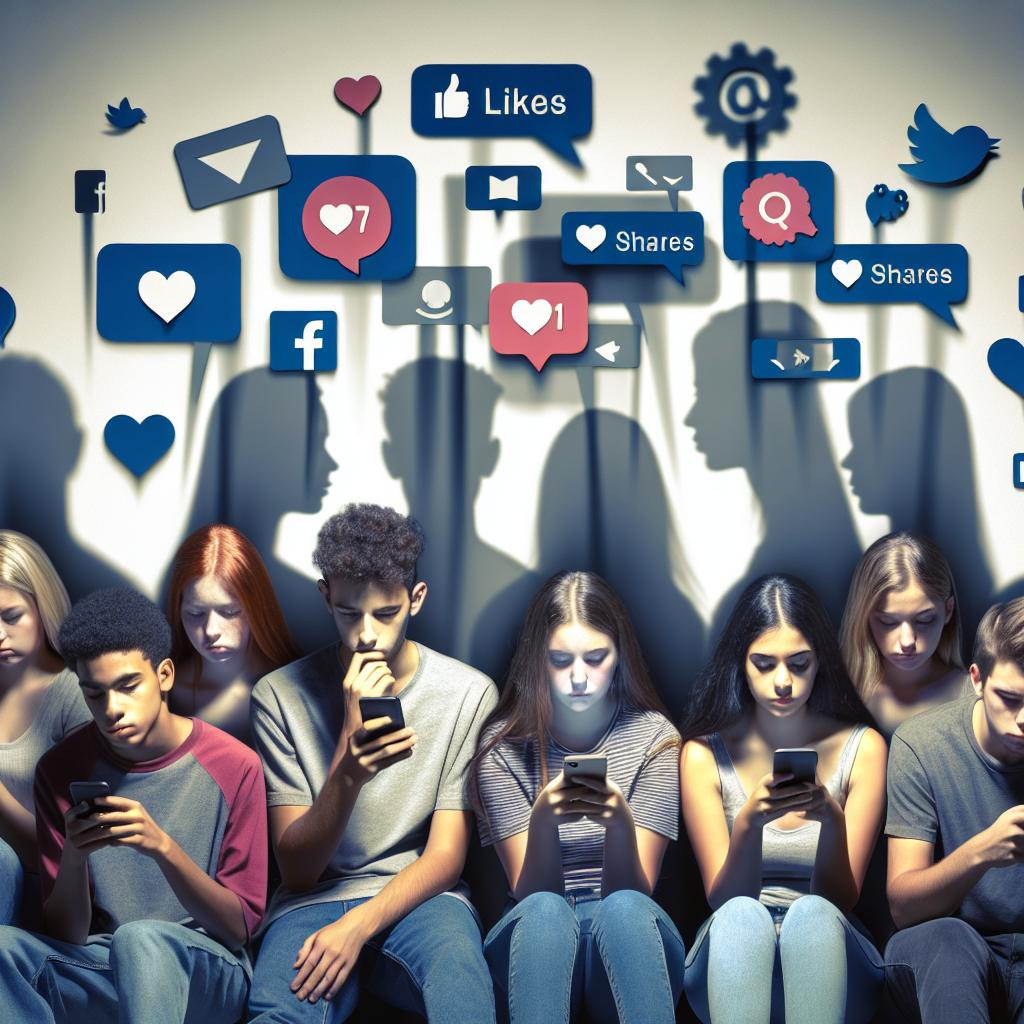
This is the section I always feel most strongly about — because the research here is very clear and very concerning.
A three-year longitudinal study led by researchers at the University of North Carolina at Chapel Hill followed 169 adolescents, who were about 12.9 years old on average at the start. Habitual social-media checking was associated with different developmental trajectories in brain responses while anticipating social feedback. The study found associations, not proof that checking caused those changes. Read the JAMA Pediatrics study.
The findings were more nuanced than simply becoming “hypersensitive”. Adolescents who checked habitually showed different patterns of neural sensitivity over time compared with those who checked less often. The authors said more research is needed to understand what these differences mean for later development and well-being.
This is relevant for families in India too. For some teenagers, likes, followers, and views can become visible measures of peer feedback. But young people’s experiences vary, and social media can also provide friendship, creativity, information, and support.
Brain development continues through adolescence and into early adulthood, but there is no single birthday—such as age 25—when the prefrontal cortex suddenly becomes fully mature. Development varies across people and across different cognitive abilities.
Young people are still developing skills for managing attention, emotions, and social feedback. It is worth helping them build thoughtful digital habits rather than assuming that every online interaction is harmful.
A Statistic That Needed Checking
I could not verify the claim that a July 2025 study tracked 500 people and found a 35% decline in prefrontal impulse control after more than two hours of scrolling. The Cureus EEG paper discussed above studied 100 adults during 30-minute sessions; it did not report that result. I have removed the unsupported statistic rather than present it as established evidence.
That distinction matters: brainwave measurements during a short task cannot be converted into a percentage loss of impulse control without a validated measure and an appropriate study design.
Executive functions such as planning, attention, and impulse regulation involve distributed brain networks. They are influenced by many factors, including sleep, stress, development, and the demands of a particular task.
Current evidence does not justify saying that ordinary scrolling permanently weakens the prefrontal cortex.
I am not saying this to make you feel bad about your phone use. The evidence does not show that ordinary scrolling inevitably damages the brain. It does show why it is worth paying attention to how often we check, what we consume, and how our habits make us feel.
It Does Not Have to Be This Way
Here is what I want you to hold onto after reading all of this.
Your brain is not broken. Social media has not permanently damaged you. The brain remains capable of adapting throughout life, and that means digital habits can also change with practice and support.
Research on reducing social-media use is promising but mixed. A 2025 meta-analysis of 20 randomized controlled trials found that effects on well-being varied across studies and outcomes. Another 2025 meta-analysis found a small average improvement in subjective well-being after restriction, with considerable variation. There is no universal evidence that one week reliably restores attention or cognitive function. Read the 2025 randomized-trial meta-analysis.
Some people find that changing their habits improves their mood, sleep, or sense of control. The pace and benefits differ, so a short break should be treated as an experiment in personal well-being rather than a guaranteed neurological reset.
A few practical changes worth trying:
Turn off non-essential notifications if they interrupt you. Reducing alerts may make checking less automatic, although it will not work the same way for everyone.
Set specific times for social media. Not scrolling whenever boredom hits — but intentional check-ins at set times. This gives your brain back its sense of agency.
Replace some scrolling time with activities you find meaningful—reading, writing, cooking, exercise, or an uninterrupted conversation. These habits can create space for focused attention, although it would be too strong to claim that they directly rebuild brain circuits damaged by scrolling.
Finally, notice how you feel after scrolling compared with how you feel after a genuine conversation or a walk. Your own experience is useful feedback about your habits, even though it is not a clinical measure.
One Last Thought
Oxford naming “brain rot” the word of 2024 reflected a growing public conversation about online habits. A popular phrase can capture a concern, but it does not replace careful research.
Now we have the name. Research is beginning to clarify some mechanisms, but many questions remain.
What we do with that understanding — that is the part only we can decide.
Your brain built civilisations. It wrote symphonies. It raised children and buried parents, fell in love, and got back up after heartbreak. It is the most complex object in the known universe.
It deserves better than an infinite scroll.
Jagadish Mokashi is a psychology blogger and AI Ethics writer based in India. He writes at jmmindmint.com/ — Simple Psychology and AI Ethics for Everyday Life.
Related Reading
- Why Humans Compare Themselves to Others: The Modern Comparison Trap
- Why Social Media Can Leave You Feeling Empty
- Why We Open Our Phones Automatically: The Psychology of Digital Habits
References and Further Reading
- Satani, A., Satani, K., Barodia, P., & Joshi, H. (2025). Modern Day High: The Neurocognitive Impact of Social Media Usage. Cureus, 17(7), e87496. This exploratory EEG study included 100 adults and 30-minute sessions; its limitations should be considered.
- Maza, M. T., Fox, K. A., Kwon, S.-J., et al. (2023). Association of Habitual Checking Behaviors on Social Media With Longitudinal Functional Brain Development. JAMA Pediatrics, 177(2), 160–167.
- Lindström, B., et al. (2021). A computational reward learning account of social media engagement. Nature Communications, 12, 1311.
- Oxford Languages. (2024, December 2). “Brain rot” named Oxford Word of the Year 2024.
- Burnell, K., Meter, D. J., Andrade, F. C., Slocum, A. N., & George, M. J. (2025). The effects of social media restriction: Meta-analytic evidence from randomized controlled trials. SSM – Mental Health, 7, 100459.
- Ramadhan, R. N., et al. (2024). Impacts of digital social media detox for mental health: A systematic review and meta-analysis. Narra J, 4(2), e786.