By Jagadish Mokashi | JM MindMint
How can a court evaluate a witness’s memory? What can a psychological assessment tell us about a person’s mental state? Why might two people respond differently to the same stressful event?
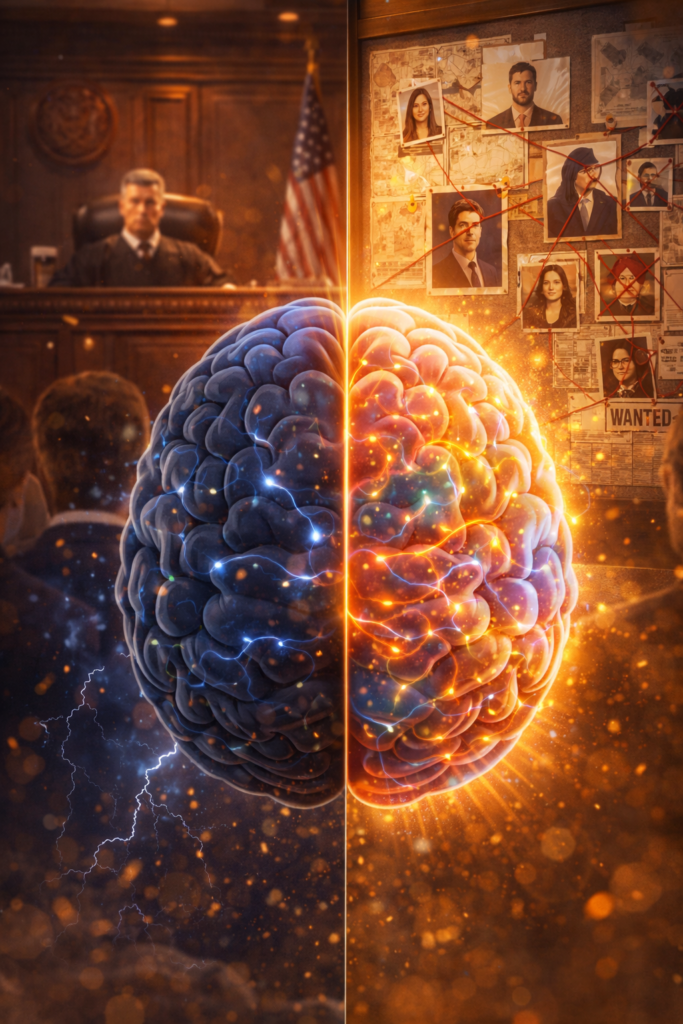
These questions show why psychology can be relevant to the legal system. Forensic psychology applies psychological knowledge and methods to legal questions. It can help courts, lawyers, correctional services, and other decision-makers understand behaviour, memory, mental health, risk, and human factors in legal proceedings.
Forensic psychology is not the same as criminal profiling, and it does not allow a psychologist to determine guilt by reading someone’s personality. Its value comes from careful assessment, transparent methods, evidence-based interpretation, and clear explanations of what the available information can—and cannot—show.
What Is Forensic Psychology?
Forensic psychology is the application of psychological science and professional practice to legal, judicial, administrative, and correctional matters. The American Psychological Association’s Specialty Guidelines describe it as the use of psychological knowledge to assist with questions arising in legal and related settings. Read the APA Specialty Guidelines for Forensic Psychology.
Forensic psychologists may work in several areas, including:
- Psychological assessment: evaluating relevant mental-health, cognitive, developmental, or behavioural questions within the limits of professional competence.
- Criminal and civil proceedings: providing expert opinions on specific psychological issues that a court needs to understand.
- Eyewitness memory: explaining how attention, stress, memory, and questioning can affect what a witness recalls.
- Family and child matters: conducting appropriate evaluations in cases involving parenting, child welfare, or family disputes.
- Correctional settings: contributing to rehabilitation planning, treatment, and assessments of needs or risk.
- Research and consultation: helping legal professionals understand psychological evidence and the limits of particular methods.
The exact role depends on the legal question, the jurisdiction, and the psychologist’s training. A psychologist who provides therapy is not automatically qualified to conduct every type of forensic evaluation.
How Psychology Can Assist a Court
Courts make decisions using evidence and the applicable law. Psychological expertise may help explain a question that requires specialised knowledge—for example, whether a particular assessment is scientifically appropriate, how memory can be influenced, or what a psychological evaluation does and does not establish.
An expert’s role is to explain methods, findings, limitations, and alternative interpretations. The expert does not replace the judge or jury, and an opinion is not automatically conclusive. The decision-maker must consider the expert evidence alongside the other evidence in the case.
In India, Section 39 of the Bharatiya Sakshya Adhiniyam, 2023 addresses the relevance of expert opinions on matters of science, art, and other specialised fields. The Act came into force on 1 July 2024. Consult the official India Code portal and the text of the Bharatiya Sakshya Adhiniyam. The court remains responsible for evaluating the evidence and deciding what weight to give it.
Understanding Criminal Behaviour Without Oversimplifying It
Criminal behaviour cannot be explained by one personality trait, one diagnosis, or one childhood experience. Behaviour is influenced by multiple factors, which may include personal history, social environment, opportunity, relationships, substance use, situational pressures, and individual decision-making.
Psychological research can help explore relevant factors, but it should not be used to stereotype people or predict guilt from appearance, background, or a supposed personality type. Most people with a mental-health condition are not violent, and a diagnosis by itself does not establish that someone has committed an offence.
Forensic assessment focuses on the specific question being asked. Depending on the case, that may involve a person’s current mental state, cognitive functioning, developmental needs, or another issue relevant to the proceedings. Conclusions should be based on appropriate methods and sufficient information—not assumptions.
Eyewitness Testimony: Why Human Memory Needs Care
Eyewitness testimony can be important, but memory is not a video recording. A witness may only see part of an event, may be distracted, may experience stress, or may have limited time to observe what happened. Later conversations, photographs, media coverage, and the wording of questions can also influence recall.
Confidence and accuracy are not the same thing. A witness may feel very confident and still be mistaken, especially if confidence has been influenced by feedback or repeated questioning after the original identification.
The U.S. National Academies report Identifying the Culprit: Assessing Eyewitness Identification recommends procedures designed to reduce suggestion and preserve the reliability of identification evidence. These include using fair identification procedures, avoiding administrator influence, and recording a witness’s confidence in their own words at the time of the first identification. Read the National Academies report.
Forensic psychologists may explain research on perception, memory, stress, and suggestibility. They generally cannot determine from a witness’s confidence alone whether a particular identification is correct. The facts of each case and the procedures used must be examined carefully.
Psychological Assessment and Mental State Questions
Some legal questions require an assessment of a person’s mental state or functioning at a particular time. Depending on the jurisdiction and the issue, an evaluation may consider clinical interviews, relevant records, validated psychological measures, collateral information, and observations.
Different legal questions require different assessments. A question about a person’s current ability to participate in proceedings is not the same as a question about their mental state at the time of an alleged offence. A diagnosis alone does not answer either question.
Good forensic practice requires the evaluator to explain the purpose of the assessment, the sources of information, the limits of confidentiality, and the limits of the conclusions. The APA guidelines emphasise competence, impartiality, scientific foundations, and transparency about limitations.
Criminal Profiling: Useful Hypothesis or Overstated Promise?
Criminal profiling is often portrayed in films as a way to identify an offender by analysing a crime scene and predicting a person’s personality. Real-world practice is more limited. Behavioural analysis may help investigators organise information or develop hypotheses, but it cannot reliably identify a specific person on its own.
A profile should never replace physical evidence, verified witness information, investigative procedure, or due process. Broad personality descriptions can fit many people, and investigators may be vulnerable to confirmation bias if they focus only on details that support an early theory.
Forensic psychology is strongest when it helps decision-makers ask better questions, evaluate evidence carefully, and recognise uncertainty—not when it promises certainty from a behavioural pattern.
Ethics, Bias, and the Limits of Expert Opinion
Forensic work can affect liberty, family relationships, reputation, and access to services. That makes ethical practice essential. Professionals should work within their competence, use appropriate methods, consider alternative explanations, and communicate findings in language that decision-makers can understand.
Evaluators should also consider cultural, language, disability, age, and socioeconomic factors where they are relevant. A test that has not been validated for a person’s language or circumstances may not support the same conclusions as it would in the population for which it was developed.
Experts should distinguish direct observations from interpretations and opinions. They should disclose important limitations and avoid presenting uncertain conclusions as facts. The court must remain free to assess the expert’s reasoning rather than simply accepting a professional title.
Key Takeaways
- Forensic psychology applies psychological science to legal and justice-related questions.
- It includes assessment, expert consultation, eyewitness-memory research, family matters, and correctional work.
- Psychologists can explain evidence and limitations; they do not decide guilt.
- Eyewitness memory can be affected by attention, stress, suggestion, and later information.
- Criminal profiling can generate hypotheses but cannot identify an offender by itself.
- Ethical forensic practice requires competence, impartiality, transparent methods, and careful communication of uncertainty.
- In India, Section 39 of the Bharatiya Sakshya Adhiniyam, 2023 addresses expert opinions in specialised fields.
Conclusion
Forensic psychology connects the study of human behaviour with the practical questions raised by legal proceedings. It can help courts understand memory, mental state, assessment methods, and the limits of psychological evidence.
But psychology is not a shortcut to certainty. A responsible expert explains what the evidence supports, what remains uncertain, and what cannot be concluded. Fair justice depends on careful investigation, reliable evidence, appropriate professional expertise, and respect for the rights of everyone involved.
References and Further Reading
- American Psychological Association. (2013). Specialty Guidelines for Forensic Psychology.
- National Research Council. (2014). Identifying the Culprit: Assessing Eyewitness Identification. The National Academies Press.
- Government of India. (2023). Bharatiya Sakshya Adhiniyam, 2023, Section 39: Opinions of experts.
This article is for general education. It is not legal advice, a forensic assessment, or a substitute for consulting a qualified lawyer or appropriately trained professional about a specific case.
About the Author: Jagadish Mokashi is the founder of JM MindMint, a platform exploring psychology, human behaviour, digital life, and AI ethics.