You may have heard that logical people are “left-brained” while creative people are “right-brained.” It is a popular way to describe thinking styles, but neuroscience does not support dividing people into two personality types based on one dominant hemisphere.
The real science is more interesting. The two cerebral hemispheres are connected and cooperate, while some functions show a degree of lateralisation—meaning that one side tends to contribute more strongly to a particular task. This guide explains what is true, what is exaggerated and why both hemispheres matter.
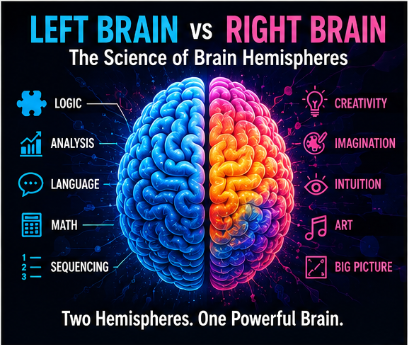
What are the left and right hemispheres?
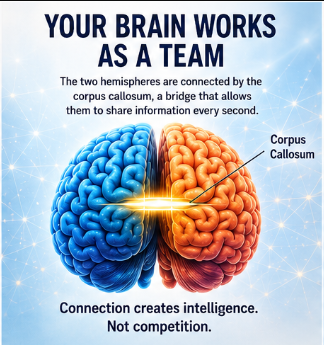
The cerebrum has two hemispheres, left and right, separated by a deep groove. They are connected by bundles of nerve fibres, including the corpus callosum, which allows information to be shared between them.
Each hemisphere has regions that contribute to perception, movement, language, memory and other processes. The hemispheres are not independent brains, and most complex everyday activities rely on communication across networks that include both sides.
What is brain lateralisation?
Brain lateralisation refers to the tendency for some functions or processing networks to be more strongly associated with one hemisphere than the other. This is a genuine feature of brain organisation. It does not mean that one side controls an entire personality or that a person uses only one hemisphere.
For example, language is left-lateralised in many people, especially for important aspects of speech and language processing. Some aspects of spatial attention and emotional prosody show right-hemisphere biases. These are broad tendencies, not rigid rules that apply identically to everyone.
What does the left hemisphere tend to contribute?
In many people, the left hemisphere plays a major role in language processes such as producing and understanding speech, reading and aspects of grammar. It also contributes to movement and sensory processing, reasoning and other tasks. These functions are distributed across networks; they are not confined to one small area or one side alone.
What does the right hemisphere tend to contribute?
The right hemisphere contributes to spatial attention, aspects of visual processing, recognising some patterns and interpreting emotional tone or prosody in speech. It also participates in many other tasks, including language and memory. Describing it simply as the “creative side” leaves out the complexity of its functions.
Why did the left-brain versus right-brain personality idea become popular?
Research on brain asymmetry and specialised functions helped establish that the hemispheres are not identical in every respect. Studies of people who had undergone split-brain surgery also provided important evidence about how some functions can be lateralised. Popular accounts later simplified these findings into a personality story: left-brained people were said to be logical and organised, while right-brained people were described as artistic and intuitive.
The simplified story goes beyond the evidence. A finding that a particular task relies more on one hemisphere does not show that a whole person has a dominant side that determines their personality, intelligence or career interests.
What does research say about the myth?
Nielsen and colleagues (2013) examined resting-state brain connectivity in more than 1,000 people to test whether individuals showed a general tendency toward left-brain or right-brain dominance. They found lateralised connections in particular networks, but did not find evidence for a general whole-brain left-dominant or right-dominant personality pattern.
Corballis (2014), in a review titled “Left Brain, Right Brain: Facts and Fantasies,” explained how real asymmetries became mixed with popular claims about personality and thinking styles. The evidence supports specialisation in some functions, not the idea that creativity belongs only to one side or logic only to the other.
How do the hemispheres work together?
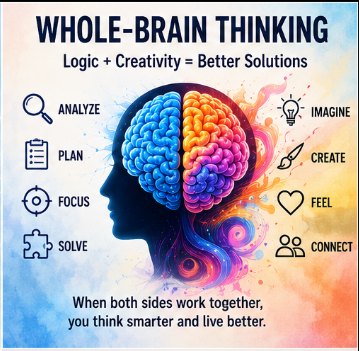
Everyday activities require information to be integrated. Reading a story, for example, involves recognising words, understanding language, using memory, following meaning and responding emotionally. Playing music may involve auditory processing, timing, movement, memory, attention and emotional interpretation. These tasks are supported by connected networks, not one hemisphere working alone.
The corpus callosum is one major pathway that allows the hemispheres to exchange information. Other connections within and between brain networks also contribute. Cooperation helps the brain combine specialised processing into a coherent response.
Does handedness determine which hemisphere you use?
Handedness is related to some patterns of brain lateralisation, but it does not determine a person’s personality or provide a simple map of all their abilities. Many right-handed people show left-hemisphere language dominance, while patterns among left-handed people are more variable. Individual brain organisation cannot be reliably inferred from a personality quiz or writing hand alone.
Can you train one side of the brain?
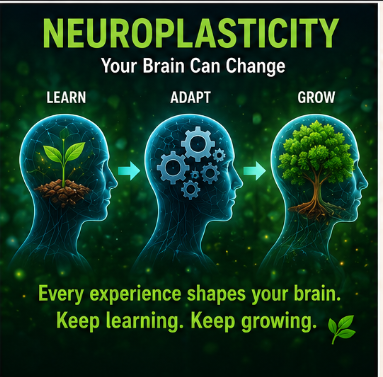
You can practise particular skills—such as drawing, language learning, calculation, music or spatial navigation—but it is misleading to describe this as training only the left or right hemisphere. Skills usually involve networks across the brain. Practice, feedback and experience can improve performance in the skills you work on.
If you want to develop creativity, try activities that involve exploration, making, experimentation and reflection. If you want to improve analytical skills, practise structured reasoning, problem-solving and checking evidence. These are useful goals without assigning them to a single side of the brain.
Common myths and the evidence
- Myth: Logical people are left-brained. Evidence: reasoning involves distributed networks and contributions from both hemispheres.
- Myth: Creative people are right-brained. Evidence: creativity involves multiple processes, including memory, attention, knowledge, evaluation and imagination.
- Myth: One hemisphere is more powerful. Evidence: the hemispheres have specialised contributions and work together; neither is a universal “better” side.
- Myth: Your dominant hemisphere determines your career. Evidence: career interests and skills are shaped by learning, experience, values, opportunity and many cognitive abilities.
- Myth: You can improve intelligence by activating the unused side. Evidence: there is no dormant hemisphere waiting to be switched on. Practising relevant skills is a more realistic approach.
Why this matters for learning and self-understanding
Personality labels can feel simple and memorable, but they may limit how people see their own abilities. A student who believes they are “not a maths person” may avoid practising, while someone who thinks they are “not creative” may overlook opportunities to develop new skills.
People can develop different strengths through learning and practice. Instead of asking which side of your brain you use, ask which skill you want to build, what practice it requires and what feedback can help you improve.
Frequently asked questions
Are people either left-brained or right-brained?
No. Some brain functions are lateralised, but there is no reliable scientific basis for dividing people into left-brained and right-brained personality types.
Is language controlled by the left hemisphere?
Language is left-lateralised in many people, but both hemispheres contribute to communication. The exact organisation varies between individuals and across language tasks.
Does the right hemisphere control creativity?
No. Creative work involves multiple cognitive processes and networks across both hemispheres. It cannot be assigned to the right side alone.
Can brain training make one hemisphere stronger?
Practising a skill can improve performance on that skill, but this should not be understood as strengthening one hemisphere to create a particular personality. Learning usually involves connected networks.
What is the most accurate way to understand the two hemispheres?
They have some specialised functions and communicate continuously. The brain works as an integrated system, and neither side determines a person’s overall intelligence or character.
References and further reading
- Nielsen et al. (2013): An Evaluation of the Left-Brain vs. Right-Brain Hypothesis with Resting State Functional Connectivity MRI.
- Corballis (2014): Left Brain, Right Brain: Facts and Fantasies.
- Ries et al. (2016): Choosing Words: Left Hemisphere, Right Hemisphere, or Both?.
- Rogers (2021): Brain Lateralization and Cognitive Capacity.
- National Institute of Neurological Disorders and Stroke: Brain Basics.
For related reading, explore our guide to the human brain, memory and focus strategies and what research says about intelligence.
JM MindMint provides general educational information about psychology and neuroscience. It is not a substitute for medical advice or neurological assessment.