People often say that attitudes shape behaviour: someone who values exercise should be active, someone who cares about the environment should make sustainable choices, or someone who believes education matters should study consistently. In real life, the relationship is not always that simple. People can sincerely hold an attitude and still act differently when time, habits, social pressure, resources or opportunity get in the way.
Social psychology studies this relationship as the attitude–behaviour gap. Understanding it helps explain why good intentions sometimes fail to become action, how attitudes can change and what makes an attitude more likely to guide behaviour.

What is the attitude–behaviour gap?
An attitude is an evaluation of a person, object, issue or behaviour. It may be favourable, unfavourable or mixed. Behaviour is what a person actually does. The attitude–behaviour gap describes situations where a person’s stated evaluation or intention does not match their action.
For example, a person may believe that regular exercise is beneficial but rarely exercise because of long work hours, pain, caregiving duties or lack of a safe place to be active. The attitude may be genuine; the conditions for acting on it may be difficult.
Why do attitudes not always predict behaviour?
1. A general attitude may not match a specific action
Someone may have a positive attitude toward health in general but still struggle to choose a particular behaviour, such as preparing a balanced meal every evening. Broad opinions are often weaker predictors of specific actions than attitudes that closely match the behaviour, setting and time being considered.
2. Habits can operate automatically
People often repeat familiar routines without making a fresh decision each time. A person may value saving money but still make an unplanned purchase when tired or responding to a familiar cue. Habits, convenience and immediate rewards can influence behaviour alongside attitudes.
3. Social expectations matter
People may act differently depending on what family, peers, colleagues or a wider community expect. Someone may personally support a choice but avoid it because they fear criticism or want to maintain belonging. Social norms can encourage or discourage behaviour.
4. Perceived control and real-world barriers matter
Good intentions may not become action when a person lacks time, money, access, skills, information or physical ability. Believing that an action is worthwhile does not automatically provide the resources needed to do it.
5. Feelings and circumstances can change
An attitude may be stable in one situation but less influential when a person is stressed, distracted, tired or under time pressure. Immediate emotion and the practical demands of a situation can affect decisions.
What makes an attitude more likely to guide behaviour?
Research suggests that attitudes are more predictive when they are strong, stable, easy to bring to mind and based on relevant experience. The attitude should also correspond closely to the behaviour being measured. For example, a specific attitude toward walking to work is more relevant to that action than a broad statement about liking exercise.
Glasman and Albarracín’s 2006 meta-analysis found that attitude accessibility and stability help explain the relationship between attitudes and later behaviour. This does not mean attitudes determine action; it means some attitudes are more likely than others to influence what a person does.
The Theory of Planned Behaviour
Psychologist Icek Ajzen’s Theory of Planned Behaviour is one influential framework for understanding how attitudes relate to action. It proposes that a person’s intention to perform a behaviour is influenced by three broad factors:
- Attitude toward the behaviour: whether the person evaluates the action positively or negatively.
- Subjective norms: whether the person believes that important others approve or expect the action.
- Perceived behavioural control: whether the person believes they can carry out the action, given the skills and barriers they anticipate.
These factors help explain intention, but intention is not the same as behaviour. Actual control and opportunity still matter. A person may intend to attend a class but be unable to travel there because of illness or a work emergency.
How can attitudes change?
Attitudes can change through new information, direct experience, discussion, reflection and persuasive communication. Some attitudes are easier to change than others. Strong attitudes that are closely connected to identity or repeated experience may be more resistant, while uncertain attitudes may shift when a person encounters relevant evidence.
Persuasion and information
People may reconsider an attitude when they receive credible information that is relevant to their concerns. The quality of the argument, the trustworthiness of the source, prior beliefs and the person’s interest in the topic can all matter. Repeating a message more loudly does not guarantee that someone will accept it.
Direct experience
Trying an activity or interacting with something personally can change an attitude. A student who expects a subject to be impossible may develop a more positive view after receiving useful instruction and experiencing progress. A negative experience can also strengthen avoidance, so the context and support matter.
Reflection and cognitive consistency
People may notice tension between what they believe and what they do. This can prompt reflection, but it does not always produce change. Someone may adjust their behaviour, revise their attitude or explain the inconsistency in another way. Understanding the reason for the gap is more useful than assuming the person is dishonest.
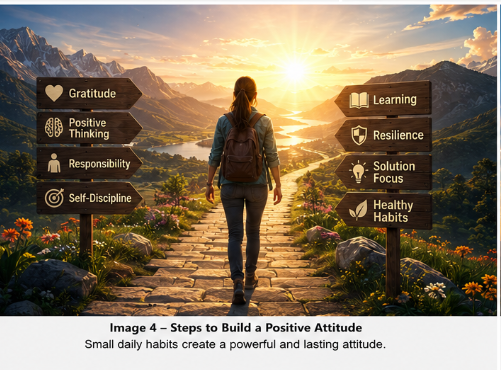
How to turn intentions into realistic action
1. Make the attitude specific
Instead of saying “I want to be healthier,” choose a behaviour you can describe: “I will walk for fifteen minutes after lunch on three days this week.” Specific actions are easier to plan and review.
2. Identify the real barrier
Ask what makes the action difficult. Is it time, cost, access, confidence, pain, social pressure or forgetfulness? Different barriers need different solutions. More motivation will not solve every practical problem.
3. Create a clear cue and plan
Decide when and where the action will happen. For example, “After I finish lunch on Monday, Wednesday and Friday, I will take a short walk.” A clear cue can help turn an intention into a routine.
4. Make the first step manageable
Start with a version of the action that fits your current circumstances. A small, repeatable step can help build confidence and reveal what needs to change before setting a larger goal.
5. Ask for support where useful
Support from a friend, teacher, colleague or family member can make a behaviour easier. Choose support that respects your needs rather than creating shame or pressure.
6. Review outcomes without self-blame
If the plan does not work, ask what happened and adjust it. A missed action may reveal a scheduling problem, unrealistic goal or missing resource. It does not prove that your attitude is weak.
What this means for relationships and communication
When someone behaves differently from what they say they believe, it is tempting to accuse them of hypocrisy. Sometimes a person is being inconsistent, but there may also be barriers, competing priorities or mixed feelings. Asking respectful questions can reveal more than making assumptions.
In families, schools and workplaces, supportive environments can make desired behaviours easier. Clear expectations, practical resources, fair rules and opportunities to participate can help bridge the gap between intention and action.
Frequently asked questions
Does attitude always determine behaviour?
No. Attitudes can influence behaviour, especially when they are strong and relevant, but habits, social norms, practical barriers and opportunities also matter.
Why do people do things they disagree with?
People may act under pressure, follow habits, respond to immediate needs or lack realistic alternatives. They may also hold mixed attitudes or change their mind in a particular situation.
Can changing an attitude change behaviour?
It can help, but attitude change alone may not be enough. People may also need skills, resources, supportive social conditions and a practical opportunity to act.
What is the Theory of Planned Behaviour?
It is a social psychology framework proposing that attitudes toward a behaviour, perceived social expectations and perceived behavioural control help shape intentions. Actual behaviour also depends on real opportunities and control.
How can I become more consistent with my intentions?
Choose a specific action, identify barriers, create a cue, start with a manageable step and review what happens. Adjust the plan instead of judging yourself for every setback.
References and further reading
- Glasman & Albarracín (2006): Forming Attitudes That Predict Future Behavior: A Meta-Analysis of the Attitude–Behavior Relation.
- Ajzen (1991): The Theory of Planned Behavior.
- Wood (2000): Attitude Change: Persuasion and Social Influence.
- Research on cognitive-affective inconsistency and the attitude–behaviour relationship.
For the foundational explanation of attitudes and the ABC model, read What Is Attitude? Meaning, the ABC Model and How Attitudes Shape Behaviour. You can also explore mindset and personal growth and positive psychology and well-being.
JM MindMint provides general educational information about psychology. It is not a substitute for professional advice or individual assessment.