Positive thinking is often presented as a simple instruction: look on the bright side and everything will improve. Real life is more complicated. A constructive outlook can help people notice options, stay engaged with meaningful goals and respond to setbacks, but it cannot remove every obstacle or guarantee success.
A healthier definition of positive thinking is realistic, flexible thinking that leaves room for hope while acknowledging facts and difficult emotions. It is not pretending that everything is fine. It is learning to respond to challenges without assuming that the worst outcome is certain.

What is positive thinking?
Positive thinking is a way of interpreting experiences that gives appropriate attention to possibilities, strengths and workable next steps. It can include expecting that effort may help, recognising progress and considering more than one explanation for a setback.
It does not mean ignoring risks, denying sadness or believing that thoughts alone control events. A person can be hopeful and still prepare carefully, ask for help, set boundaries or change a plan when evidence shows that something is not working.
The psychology behind optimism
Psychologists often study optimism as a general expectation that good outcomes are possible. Optimism can influence how people approach goals and cope with difficulty, but it is not the same as constant happiness or certainty that everything will work out.
Research has found associations between optimism and some health and well-being outcomes. For example, a meta-analytic review by Rasmussen and colleagues examined optimism in relation to physical health. Such findings do not prove that positive thoughts alone cause better health. Factors such as behaviour, resources, social support, access to care and underlying circumstances may also contribute.

Positive thinking and the way we respond to stress
Two people can face the same setback and interpret it differently. One may think, “I made a mistake, so I will never succeed.” Another may think, “This did not work; I can understand why and decide what to try next.” The second response does not deny the disappointment. It creates room for problem-solving.
In emotion-regulation research, cognitive reappraisal means reconsidering the meaning of a situation in a way that may change its emotional impact. Reappraisal is not forced positivity. It should be grounded in plausible explanations and should not be used to excuse mistreatment or dismiss real danger.
Positive thinking is not toxic positivity
It is important to distinguish constructive optimism from pressure to appear positive all the time.
Constructive, realistic optimism
- Acknowledges that a situation may be difficult.
- Allows sadness, anger, fear or disappointment without shame.
- Looks for practical options and sources of support.
- Can accept uncertainty and change a plan when needed.
Toxic positivity
- Dismisses distress with phrases such as “just be happy” or “everything happens for a reason.”
- Pressures people to hide difficult feelings.
- Suggests that negative outcomes happen because someone did not think positively enough.
- Can discourage people from seeking help or addressing genuine problems.
People do not need to feel positive every day. Difficult emotions are part of human experience, and acknowledging them can be a healthier starting point than trying to push them away.

What does research say about positive psychology?
Positive psychology studies strengths, well-being, meaning, relationships and conditions that help people function and flourish. It does not claim that positive thinking can cure illness or solve structural problems.
Meta-analyses of positive psychology interventions have found that some structured activities can produce improvements in subjective well-being and depressive symptoms, although effects vary and are not a replacement for appropriate mental-health treatment. These interventions may include practices such as gratitude exercises, identifying personal strengths, acts of kindness or setting meaningful goals. The quality, duration and setting of an intervention matter.
Fredrickson’s broaden-and-build theory proposes that some positive emotions can broaden a person’s momentary range of thoughts and possible actions, and may help build longer-term personal resources. This is a theory supported by a body of research, not a promise that feeling happy automatically makes every decision better.
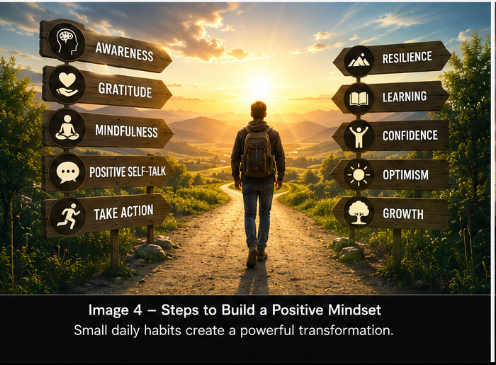
Practical ways to develop a more constructive outlook
1. Notice your automatic thoughts
When something goes wrong, write down the first thought that appears. Is it a fact, a prediction or an interpretation? For example, “I made one mistake” is different from “I always fail.” Separating the event from the conclusion can make the next step clearer.
2. Replace extreme conclusions with balanced statements
You do not have to replace a negative thought with an unrealistically positive one. Try a statement that is accurate and useful: “This is difficult, but I can take one step and ask for help if needed.” Balanced thinking is more sustainable than repeating phrases you do not believe.
3. Focus on what is within your influence
Some circumstances cannot be changed immediately. Identify the part you can influence: gathering information, preparing for a conversation, making a plan, seeking support or deciding what boundary is needed. This helps direct effort without blaming yourself for factors outside your control.
4. Recognise small progress
Notice actions that move you toward a goal, even when the final result is not yet visible. Progress might mean completing a task, asking a question, practising a skill or returning to a routine after a setback. Recognising progress is not the same as pretending that the work is finished.
5. Practise gratitude without denying difficulty
You might write down one thing you appreciate and one thing that is difficult today. Both can be true. Gratitude is most useful when it feels genuine rather than like an obligation to ignore pain or hardship.
6. Spend time with supportive people
Supportive relationships can offer perspective, encouragement and practical help. Choose people who can listen without judgement and who respect your feelings. If a situation involves harm, coercion or abuse, positivity is not the solution; safety and appropriate support come first.
7. Set goals that are specific and realistic
Turn a broad wish such as “I want a better life” into a small action you can begin. Decide what you will do, when you will do it and what might get in the way. Make room to adjust the plan as circumstances change.
8. Look after your physical well-being
Sleep, movement, nourishment and medical care can affect energy and mood. These habits support general health, but they do not guarantee a positive mood or replace treatment for mental or physical health conditions.
Common mistakes to avoid
- Comparing your life with someone else’s highlight reel: social media rarely shows the full context of another person’s life.
- Blaming yourself for every setback: outcomes are influenced by resources, opportunity, health, other people and chance, as well as personal choices.
- Using affirmations you do not believe: choose realistic statements that you can practise and support with action.
- Ignoring practical problems: hope works best alongside planning, information and problem-solving.
- Hiding distress: you are allowed to ask for support and speak honestly about difficult experiences.
When positive thinking is not enough
If low mood, anxiety, hopelessness or loss of interest is persistent or interferes with daily life, consider speaking with a qualified healthcare professional. Psychological therapy can help people understand unhelpful thinking patterns and develop coping skills. Positive thinking should never be used to suggest that someone can overcome depression, trauma or illness simply by trying harder to be optimistic.
Frequently asked questions
Does positive thinking mean ignoring problems?
No. Healthy optimism acknowledges problems and considers realistic ways to respond. Ignoring risk or dismissing genuine distress is not constructive positive thinking.
Can positive thinking improve mental health?
Some structured positive psychology activities may support well-being, but effects vary. Persistent or severe symptoms deserve appropriate assessment and evidence-based care.
Can thoughts change feelings?
Interpretations can influence emotional responses, and cognitive reappraisal is one studied emotion-regulation strategy. Feelings are also influenced by body state, memory, context and social circumstances.
Do I need to be positive all the time?
No. A realistic outlook includes the full range of human emotions. The goal is flexibility and constructive action, not constant happiness.
Is optimism the same as positive thinking?
They are related but not identical. Optimism often refers to a general expectation about future outcomes, while positive thinking can describe a broader set of ways of interpreting and responding to experiences.
References and further reading
- Bolier et al. (2013): Positive psychology interventions: a meta-analysis of randomized controlled studies.
- Lim and Tierney (2022): The Effectiveness of Positive Psychology Interventions for Promoting Well-being.
- Rasmussen, Scheier & Greenhouse (2009): Optimism and Physical Health: A Meta-analytic Review.
- Fredrickson (2001): The Role of Positive Emotions in Positive Psychology: The Broaden-and-Build Theory.
- Gross & John (2003): Individual Differences in Two Emotion Regulation Processes.
Explore related topics in our guide to mindset, understanding feelings and emotions and attitudes in psychology.
JM MindMint provides general educational information, not diagnosis or treatment. If emotional distress is persistent or severe, consult a qualified healthcare professional.