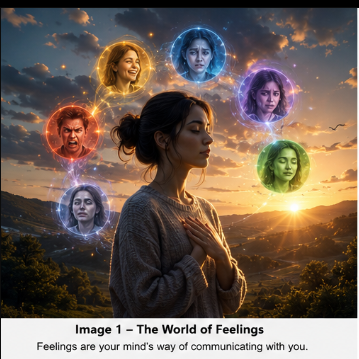
Feelings are part of everyday life. Joy can bring energy, fear can alert us to danger, sadness can signal loss, and anger can point to a boundary or problem. Feelings can be pleasant, uncomfortable or mixed. They influence attention, memory, relationships and decisions, but they do not always tell the whole story about a situation.
Understanding feelings does not mean controlling every emotion or forcing yourself to stay positive. It means learning to notice what is happening, consider what may have triggered it and choose a response that fits your values and circumstances.
What are feelings?
A feeling is the personal, conscious experience of an emotional state. It is how an emotion is experienced from the inside—for example, feeling worried, relieved, disappointed, proud or calm. Feelings can include bodily sensations and thoughts, and they may change as a person interprets what is happening.
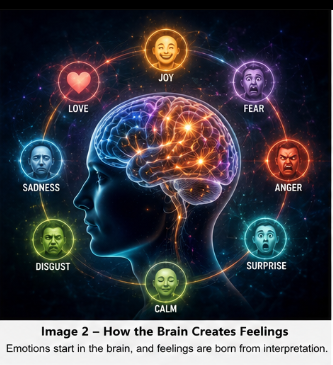
Psychologists do not always use the words emotion and feeling in exactly the same way. A useful distinction is that an emotion can refer to a broader response involving appraisal, body changes, expression, action tendencies and subjective experience, while a feeling refers more specifically to the consciously experienced part. In everyday conversation, the terms are often used interchangeably.
Feelings and emotions: how are they related?
Imagine you hear a sudden loud noise. Your attention shifts, your body may become more alert, and you may interpret the sound as a possible threat. You might experience fear and feel your heart beating faster. When you discover that the sound came from a dropped object, your interpretation and emotional response may change.
This example shows that emotional experiences involve several interacting processes. Body signals matter, but so do context, memory, expectations, attention and interpretation. A fast heartbeat alone does not tell you whether you are afraid, excited or physically exerting yourself.
Why do feelings matter?
Feelings can provide information about what matters to us. They can help us notice needs, evaluate experiences, prepare for action and communicate with other people. They are useful signals, but they are not always accurate descriptions of reality or instructions that must be followed.
- Decision-making: feelings can influence what we notice and what we consider important, while careful reasoning helps us weigh options and consequences.
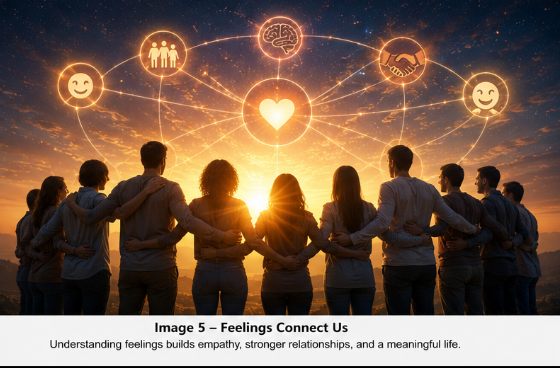
- Relationships: recognising and communicating feelings can help people explain needs, understand others and repair misunderstandings.
- Self-awareness: noticing emotional patterns can help identify stressors, values, unmet needs or situations that deserve attention.
- Safety and adaptation: emotions such as fear or disgust can help people respond to potential risks, although context is important.
How does the brain contribute to feelings?
Feelings do not come from one single “emotion centre.” They emerge from interactions among brain networks involved in body regulation, memory, attention, perception, learning and decision-making. The brain also receives information from the heart, lungs, gut, muscles and other parts of the body.
Some structures are often discussed in emotion research, but their roles are broader than one emotion:
- Amygdala: contributes to learning about emotionally important events and detecting relevant signals, including potential threats. It is not simply a fear switch.
- Prefrontal regions: support planning, attention, interpretation and regulation of responses in ways that depend on the task and context.
- Hippocampus: helps form and retrieve memories and provides context that can influence how a situation is understood.
- Insula: contributes to processing signals from inside the body and to aspects of subjective feeling and awareness.
These regions work as part of wider networks. Their activity changes with the person, the situation and the emotional experience.

Different kinds of feelings
People use many words to describe emotional experiences. Common examples include:
Pleasant feelings
Joy, affection, gratitude, hope, interest, relief, pride and contentment. These feelings can encourage connection, exploration or continued engagement with something meaningful.
Unpleasant feelings
Sadness, fear, anger, guilt, shame, frustration, jealousy and disappointment. These feelings can be difficult, but they are not automatically harmful or signs that something is wrong with a person. They may point to loss, uncertainty, conflict, unmet needs or perceived danger.
Mixed or uncertain feelings
A person may feel excited and nervous before a new opportunity, grateful and sad during a life transition, or loving and frustrated in the same relationship. Mixed feelings are common. They do not have to be resolved into one simple emotion immediately.
Why can feelings change?
Feelings can shift because the situation changes, new information appears, the body becomes tired or rested, memories are triggered, or attention moves to something else. Hunger, illness, pain, medication, sleep and stress can also affect emotional experience.
Sometimes a feeling seems to arrive without an obvious cause. That does not mean it is meaningless, nor does it prove that a hidden event or chemical imbalance is responsible. It may help to notice the feeling, check basic needs and consider recent events without rushing to a conclusion.
How to understand and manage feelings
Emotion regulation is the process of influencing which emotions arise, when they occur and how they are experienced or expressed. Research by James Gross describes several points at which people may influence an emotional response. The aim is not to eliminate emotions; it is to respond flexibly.
1. Notice the feeling without judging yourself
Pause and ask, “What am I feeling right now?” Try to observe the experience rather than immediately labelling yourself as weak, dramatic or irrational. You can acknowledge a feeling without approving of every action it might prompt.
2. Give the feeling a name
Use a specific word if you can: disappointed rather than simply bad, anxious rather than just strange, or overwhelmed rather than angry. Naming a feeling can make it easier to describe what is happening and decide what support or action may help.
3. Notice what happened before it appeared
Consider the situation, thought, memory or physical condition that came before the feeling. Ask what you needed at that moment and what meaning you gave the event. Avoid assuming that the first explanation that comes to mind must be correct.
4. Check the facts and consider another interpretation
For example, if a friend does not reply, the first thought may be “They are ignoring me.” Other explanations are possible: they may be busy, tired or away from their phone. Cognitive reappraisal means considering a different, more balanced interpretation. It is not pretending that a real problem does not exist.
5. Adjust the situation when possible
If a situation repeatedly creates unnecessary stress, consider whether something can be changed: clarify expectations, take a break, ask for help, set a boundary or divide a difficult task into smaller steps. Not every situation can be changed, but practical problem-solving may reduce avoidable strain.
6. Use attention deliberately
When you are overwhelmed, a short break, grounding exercise or shift of attention may help you regain perspective. You might focus on your breathing, notice your feet on the floor, take a short walk or return to one manageable task. Distraction can be useful for a short time, but avoiding every difficult issue may prevent it from being addressed.
7. Express feelings in a safe and respectful way
Try describing your experience without attacking another person: “I felt hurt when the plan changed without telling me” is usually more useful than “You never care about me.” Choose a safe person and a suitable time. Writing, talking, creative activity or movement can also help some people express what they are experiencing.

8. Choose how to respond, not whether you are allowed to feel
Suppressing an outward expression may sometimes be useful—for example, waiting until a meeting ends before discussing frustration. But constantly hiding feelings can make communication and support more difficult. Research comparing cognitive reappraisal and expressive suppression suggests that these strategies can have different emotional and social consequences. The most helpful approach depends on the context.
9. Look after the body as well as the mind
Sleep, regular meals, movement, rest and medical care can affect how manageable emotions feel. These basics do not cure every emotional difficulty, but they can support general well-being. If a physical symptom or sudden mood change is persistent or concerning, discuss it with a healthcare professional.
10. Seek support when feelings become difficult to manage
If distress is persistent, affects daily life, leads to repeated conflict or makes it hard to function, a counsellor, psychologist or doctor can help. Professional support can provide a safe setting to understand patterns and learn skills suited to your needs. If you may harm yourself or someone else, seek urgent local emergency or crisis support.
Common mistakes when dealing with feelings
- Believing every feeling is a fact: feelings are real experiences, but the interpretation behind them may need checking.
- Judging yourself for having an emotion: having anger, sadness or fear does not make you a bad person. What matters is how you respond.
- Reacting immediately: when possible, pause before sending a message, making a major decision or confronting someone while highly upset.
- Trying to stay positive all the time: difficult emotions are part of life. Forced positivity can make people feel unheard or ashamed.
- Ignoring repeated distress: ongoing emotional difficulty deserves attention and, when needed, professional help.
Feelings and emotional intelligence
Emotional intelligence is often used to describe abilities related to recognising emotions, understanding them and responding effectively. It can include awareness of one’s own emotional state, sensitivity to other people’s experiences and skills for managing interactions. It is not a fixed label that determines a person’s worth, and it can be developed through reflection, feedback and practice.
Frequently asked questions
Are feelings and emotions the same?
The terms are often used interchangeably. A useful distinction is that emotion refers to a broader response involving body, attention, expression and action tendencies, while feeling often refers to the conscious experience of that response. Different psychological theories use the terms in different ways.
Can thoughts influence feelings?
Yes. How a person interprets an event can influence the emotion they experience. Body state, memory, context and social conditions also contribute, so thoughts are not the only cause.
Is it healthy to express feelings?
Expression can help people communicate needs and receive support when it is safe and respectful. The best way to express a feeling depends on the situation; sometimes it is useful to pause and choose the right time.
Can emotional regulation be learned?
Yes. Skills such as identifying feelings, checking interpretations, problem-solving, reappraisal and communicating clearly can be practised. Progress varies, and some people benefit from professional guidance.
Does a negative feeling mean something is wrong?
Not necessarily. Unpleasant feelings are part of normal human experience and can signal that something matters. Persistent, intense or disruptive distress deserves attention, but having a difficult emotion is not itself a diagnosis.
References and further reading
- Gross (1998): The Emerging Field of Emotion Regulation: An Integrative Review.
- Gross & John (2003): Individual Differences in Two Emotion Regulation Processes: Implications for Affect, Relationships, and Well-Being.
- Gross (2002): Emotion Regulation: Affective, Cognitive, and Social Consequences.
- Review of cognitive reappraisal and expressive suppression strategies.
Explore related topics in our guide to emotional balance, hormones and emotional experience and mental wellness and common psychological difficulties.
JM MindMint provides general educational information, not diagnosis or treatment. If emotional distress is persistent or severe, consult a qualified healthcare professional.