The human brain is the central organ of the nervous system. It helps us interpret the world, move, communicate, learn, remember, regulate many body functions and respond to changing situations. Although different brain regions have specialised roles, they do not work as isolated control buttons. Everyday actions emerge from networks of regions communicating with one another and with the rest of the body.
This guide introduces the brain’s major structures, the broad roles of its lobes, how nerve cells communicate and how experience can shape brain function. The aim is to explain the science clearly without relying on popular myths such as “left-brained” and “right-brained” personality types.

What is the human brain?
The brain is a complex organ made up of billions of nerve cells, called neurons, as well as supporting cells. It is protected by the skull, membranes called meninges and cerebrospinal fluid. Together with the spinal cord, it forms the central nervous system.
The brain receives information from the senses and from inside the body, combines that information with memories and expectations, and helps organise responses. It also regulates functions that happen without conscious effort, including aspects of breathing, heart rate, temperature regulation, sleep and hormone control.
How is the brain organised?
For a basic introduction, the brain is often described in terms of the cerebrum, cerebellum and brainstem. These are useful anatomical groupings, but they work together rather than operating independently.
1. Cerebrum: perception, thought and voluntary action
The cerebrum is the largest part of the brain. Its outer layer, the cerebral cortex, is involved in perception, language, planning, memory, reasoning and voluntary movement. The cerebrum has two hemispheres that communicate through bundles of nerve fibres, including the corpus callosum.
Some functions show a degree of lateralisation. For example, language is more strongly left-lateralised in many people. However, the idea that one hemisphere is creative and the other logical is an oversimplification. Most complex activities use networks that involve both sides.
2. Cerebellum: coordination and learned movement
The cerebellum sits toward the back of the brain, beneath the rear part of the cerebrum. It helps coordinate timing, balance, posture and the accuracy of movement. It also contributes to learning and refining skilled actions, such as playing an instrument or practising a sport. It does not simply “control balance”; it works with many other brain systems to make movement smooth and adaptable.
3. Brainstem: essential body functions
The brainstem connects the brain with the spinal cord. It includes the midbrain, pons and medulla. It participates in functions essential for life, including breathing, heart rate, alertness and sleep-wake regulation, and it carries information between the brain and body. Because these functions are vital, injuries or disorders affecting the brainstem can be serious.
The four lobes of the cerebral cortex
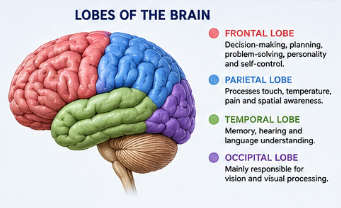
Each cerebral hemisphere is commonly described as having four lobes: frontal, parietal, temporal and occipital. Their functions overlap, and no lobe works alone. The descriptions below are broad guides rather than strict boundaries.
Frontal lobe
The frontal lobes contribute to planning, decision-making, attention, impulse control, social behaviour and voluntary movement. Parts of the frontal lobe help organise speech production. These abilities depend on connected networks, including regions outside the frontal lobes.
Parietal lobe
The parietal lobes help process touch and other body sensations, combine sensory information and support spatial awareness. They contribute to tasks such as judging where objects are, guiding movements toward them and aspects of reading and calculation.
Temporal lobe
The temporal lobes are involved in hearing, language comprehension, recognising objects and faces, and aspects of memory. Structures important for forming new memories, including the hippocampus, are located in the medial temporal region.
Occipital lobe
The occipital lobes, at the back of the brain, are central to processing visual information. Seeing is not handled by one small “vision button”: visual information is processed through connected pathways that help identify edges, colour, motion, shape and meaning.
Important structures deeper inside the brain
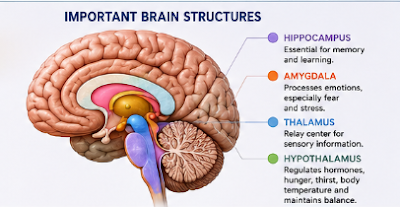
Some structures lie beneath the cerebral cortex and help coordinate emotion, memory, motivation, movement and body regulation.
- Thalamus: relays and helps organise much of the sensory and motor information travelling to and from the cerebral cortex.
- Hypothalamus: helps regulate temperature, hunger, thirst, sleep-wake rhythms, hormone systems and aspects of the body’s stress response.
- Hippocampus: important for forming and organising new memories and for aspects of spatial navigation.
- Amygdala: contributes to learning about emotionally important events and detecting signals of potential threat or reward. It is not simply a “fear centre.”
- Basal ganglia: a group of structures involved in selecting and regulating movement, habits and aspects of learning and motivation.
How do brain cells communicate?
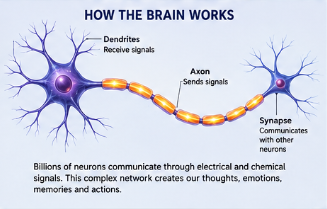
Neurons communicate using electrical changes within a cell and chemical signals between many cells. A neuron typically receives information through its dendrites and cell body. If the combined signals are sufficient, an electrical impulse travels along its axon. At many connections called synapses, the neuron releases neurotransmitters that bind to receptors on another cell.
Neurotransmitters do not have one simple meaning each. Their effects depend on the receptor, the location and the network in which they act. Glutamate is a major excitatory neurotransmitter in the brain, while GABA is a major inhibitory neurotransmitter. Dopamine, serotonin, acetylcholine and other messengers contribute to multiple processes, including movement, attention, learning, sleep and mood.
These chemical signals are only one part of communication. Neurons also change their electrical activity, adjust the strength of connections and interact with supporting cells and the body’s wider systems.
The brain, emotions and behaviour
Emotions are not produced by a single brain region. They involve interactions among networks that process body signals, memories, goals, social information and the current environment. For example, a stressful event may involve attention and interpretation, memory of similar experiences, autonomic changes such as a faster heartbeat, and decisions about what to do next.
This is why the same event can feel different to different people—or even to the same person at different times. Sleep, health, learning, culture, context and social support can all shape emotional responses. The brain and body continually influence one another.
Neuroplasticity: how experience can change the brain
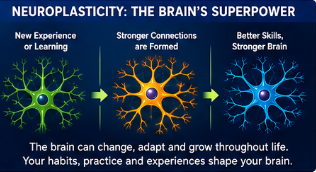
Neuroplasticity refers to the brain’s ability to change its structure or function in response to development, learning, experience, practice or injury. When a person practises a skill, the networks involved can become more efficient or reorganise. Learning a language, improving a movement or building a new routine can involve changes in how neural circuits communicate.
Plasticity does not mean that the brain can be reshaped instantly or that every repeated thought creates a permanent new pathway. Changes depend on many factors, including the type of learning, practice, age, health and environment. The practical message is that learning and rehabilitation are possible, but they take time and repetition.
How to support brain health
No single food, supplement or brain game guarantees better memory or prevents neurological disease. Several broad health practices support the body systems that the brain depends on:
- Be physically active: choose regular movement that suits your health and ability.
- Prioritise sleep: maintain a routine where possible and seek help for persistent sleep problems.
- Eat a varied diet: include a range of foods that provide adequate energy and nutrients.
- Keep learning: practise skills, read, create, ask questions and engage in activities that are meaningful to you.
- Stay socially connected: maintain supportive relationships and seek help when isolated or distressed.
- Manage health risks: follow medical advice for blood pressure, diabetes and other conditions, avoid smoking and protect your head during activities with injury risk.
These habits support general health; they do not guarantee that a person will avoid memory problems or neurological conditions. Sudden weakness, facial drooping, speech difficulty, severe sudden headache, seizure or a sudden change in awareness requires urgent medical assessment.
Frequently asked questions
Which part of the brain controls thinking?
Thinking involves networks across the brain. The cerebral cortex, including areas in the frontal and parietal lobes, contributes to reasoning, planning, attention and working with information, while memory and other systems also contribute.
Do the left and right brain control different personalities?
No. Some functions are more strongly lateralised, such as language in many people, but complex abilities use networks across both hemispheres. “Left-brained” and “right-brained” personality labels are not a reliable scientific way to describe people.
What does the cerebellum do?
The cerebellum helps coordinate movement, balance, posture and the learning of skilled actions. It works with other brain regions to adjust timing and accuracy.
Can adults develop new brain connections?
Yes. Neuroplasticity continues throughout life. Learning, practice and experience can change the strength and organisation of neural connections, although the nature and extent of change vary.
Can brain exercises increase intelligence?
Practising a task can improve performance on that task, but evidence that commercial brain games reliably increase general intelligence or transfer broadly to everyday abilities is limited. Learning useful skills and maintaining overall health are more realistic goals.
References and further reading
- National Institute of Neurological Disorders and Stroke: Brain Basics—Know Your Brain.
- Maldonado et al. (2023): Physiology, Brain. StatPearls, NCBI Bookshelf.
- StatPearls: Neuroplasticity. NCBI Bookshelf.
- Adult Neuroplasticity: More Than 40 Years of Research.
Explore related topics in our guide to brain waves and EEG, the research on intelligence and learning and educational psychology.
JM MindMint provides general educational information, not diagnosis or treatment. Sudden or concerning neurological symptoms require assessment by a qualified healthcare professional.