Most people experience negative thoughts from time to time. You might replay a conversation, worry about an upcoming task or remember a mistake. These thoughts can sometimes help us notice a problem and plan a response. They become more difficult when they repeat, feel convincing despite limited evidence or begin to interfere with sleep, relationships, work or study.
The goal is not to eliminate every negative thought or force yourself to think positively all the time. A more realistic goal is to notice unhelpful thinking, respond with curiosity and choose actions that support your well-being. This guide explains common thought patterns and practical techniques drawn from cognitive behavioural approaches.

What are negative thoughts?
Negative thoughts are thoughts with an unpleasant or critical focus. They may involve worry, self-doubt, regret, fear of failure or expectations that something will go wrong. Some are realistic responses to a genuine problem; others may be exaggerated, incomplete or based on assumptions.
Having a negative thought does not mean you are weak, ungrateful or mentally unwell. Thoughts arise automatically for many reasons, including memory, stress, learning, mood and the situation. What matters is how often they occur, how much distress they cause and whether they influence behaviour in ways that make life harder.
Negative automatic thoughts and repetitive thinking
Negative automatic thoughts are quick interpretations that appear in response to an event. For example, after receiving a short message from a friend, someone might immediately think, “They are angry with me.”
Rumination is repetitive thinking that often circles around distress, mistakes or causes without moving toward a useful solution. Worry often focuses on possible future threats. Both can feel like problem-solving, but repeated thinking may keep distress active when it does not lead to a practical next step.
Common thinking patterns that can make distress worse
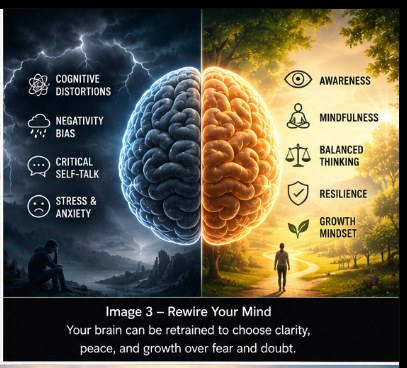
Cognitive behavioural therapy (CBT) describes several common thinking patterns. These are not diagnoses, and recognising one does not mean every thought is inaccurate. They are prompts to check whether an interpretation fits the available evidence.

1. All-or-nothing thinking
Seeing a situation in only two categories, such as complete success or total failure. Example: “If I do not get the highest mark, I have failed.” A more balanced view might recognise what went well and what needs improvement.
2. Catastrophising
Jumping to the worst possible outcome without considering how likely it is or what other outcomes may occur. Example: “If I make a mistake in this meeting, my career is over.” Ask what is most likely, what evidence supports the prediction and what you could do if a problem occurs.
3. Mind-reading
Assuming you know what another person thinks without checking. Example: “Everyone at work thinks I am incompetent.” Other people may be focused on their own tasks, and their thoughts cannot be known from one expression or brief message.
4. Overgeneralising
Using one disappointing event to make a broad conclusion. Example: “I made a mistake today, so I always make mistakes.” A single event is not enough evidence for a permanent rule.
5. Labelling yourself
Turning a behaviour or outcome into a judgement about your identity. “I handled that badly” describes an event; “I am useless” turns it into a global judgement.
6. Discounting positives
Ignoring achievements or supportive feedback while focusing only on what went wrong. A balanced account includes both strengths and areas for growth.
7. Personalisation
Taking responsibility for events that may have several causes. For example, assuming that a colleague’s quiet mood must be your fault without evidence.
Why can negative thoughts become repetitive?
Negative thinking can be influenced by stress, low mood, anxiety, uncertainty, past experiences, sleep disruption and ongoing practical problems. When a person is under pressure, attention may become more focused on possible threats or mistakes. Repeatedly reviewing a worry can then become a habit, even when it is not producing a solution.
These patterns are not simply a choice, and they are not always caused by one psychological factor. If a person is facing real danger, discrimination, financial strain or an unsafe relationship, the most useful response may be practical support and changes to the situation—not just changing their thoughts.
Evidence-informed ways to respond to negative thoughts
1. Notice the thought instead of treating it as a fact
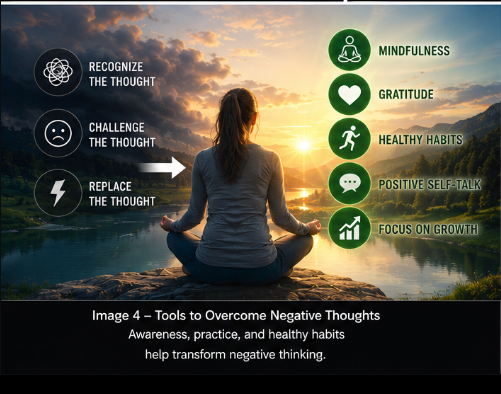
Pause and describe what is happening: “I am having the thought that I will fail.” This small change in wording can create space between the thought and the decision you make next. You do not need to argue with every thought that appears.
2. Write down the situation, thought and feeling
Use a short note with three parts: what happened, what went through your mind and what you felt. For example: “I received feedback on a report; I thought ‘I am bad at my job’; I felt ashamed and anxious.” Separating the event from the interpretation makes it easier to examine the thought.
3. Check the evidence
Ask what facts support the thought and what facts do not. Is there information you may be overlooking? Are you assuming you know what someone else thinks? Is the conclusion based on one event or a repeated pattern? The goal is accuracy, not forced optimism.
4. Create a more balanced alternative
Replace an extreme conclusion with a statement that acknowledges the difficulty and leaves room for action. For example: “The feedback shows parts of the report need work. It does not prove that I am incapable. I can clarify what needs changing and revise it.” A balanced thought should feel believable, not artificially positive.
5. Ask whether the problem needs action
Some worries point to a practical issue. If there is a task to complete, a conversation to have or information to gather, write down one next step. If there is nothing you can do right now, decide when you will revisit it rather than trying to solve it repeatedly in your head.
6. Set a brief time to think through worries
If worry keeps interrupting the day, some people find it useful to set aside a short, planned period to write down concerns and possible actions. When the worry returns outside that period, note it and gently return to the current task. This is a self-help strategy, not a substitute for treatment when anxiety is persistent or severe.
7. Shift attention toward a meaningful activity
Choose one manageable action that matters to you: prepare a meal, take a walk, complete a small task, practise a skill or contact someone supportive. Behavioural activation approaches use planned activities to help people reconnect with routines and sources of meaning, particularly when low mood has led to withdrawal.
8. Use grounding when you feel overwhelmed
Notice your feet on the floor, name a few things you can see and hear, or take a comfortable slow breath. Grounding may help you reconnect with the present moment when thoughts feel overwhelming. It is a coping tool, not a way to prove that a feared event cannot happen.
9. Reduce avoidable stress where possible
Sleep, movement, regular meals, breaks and supportive relationships can affect how manageable thoughts feel. These basics do not cure every mental health difficulty, but they can support general well-being. Address practical sources of stress when possible rather than assuming that all distress comes from thinking errors.
10. Practise with patience
Thinking habits may have developed over many years. You may notice a pattern and still fall into it again. That does not mean the practice has failed. Review what happened, make the next step smaller if needed and continue without judging yourself.
When negative thoughts may need professional support
Consider speaking with a qualified mental health professional if repetitive thoughts are persistent, cause significant distress, interfere with sleep or daily life, or occur alongside ongoing anxiety, low mood or withdrawal. CBT and other psychological approaches can help people understand and respond to unhelpful thinking patterns. The appropriate support depends on the person’s situation.
Some unwanted or intrusive thoughts can be especially distressing. Having an unwanted thought does not automatically mean you want to act on it. If thoughts involve self-harm, suicide or immediate danger, tell someone you trust and seek urgent local help. Do not rely on an online article to assess risk.
Common mistakes to avoid
- Trying to suppress every thought: pushing thoughts away can sometimes make them return more strongly. Notice them and choose where to direct attention.
- Forcing positivity: pretending that everything is fine can dismiss real problems and emotions.
- Believing every thought: thoughts are mental events, not always facts or instructions.
- Blaming yourself: negative thinking is influenced by many factors, and self-criticism rarely provides a useful plan.
- Delaying help: persistent distress deserves support; you do not have to manage everything alone.
Frequently asked questions
Is it normal to have negative thoughts every day?
People have a range of thoughts, including unpleasant ones. It becomes more concerning when thoughts are repetitive, difficult to manage or interfere with daily life.
Can I stop negative thoughts completely?
Trying to eliminate every negative thought is unrealistic. A more useful goal is to notice thoughts, check whether they are accurate and choose how to respond.
Does positive thinking help?
A balanced outlook can support coping, but forced positivity is not helpful for every situation. Acknowledge real difficulties and focus on realistic next steps.
What is the difference between rumination and problem-solving?
Problem-solving moves toward a specific decision or action. Rumination often repeats the same questions or self-criticism without producing a useful next step.
Can CBT help with negative thinking?
CBT is an evidence-based psychological treatment used for several mental health conditions. It helps people notice links between thoughts, feelings and behaviour and practise more useful responses. A qualified professional can advise whether it is appropriate.
References and further reading
- NHS: Online Self-Help CBT Techniques.
- NHS: Reframing Unhelpful Thoughts.
- National Institute of Mental Health: Depression and Treatment Options.
- The Effect of Psychological Treatment on Repetitive Negative Thinking: A Meta-Analysis.
- American Psychiatric Association: Interventions for Rumination.
For related reading, explore realistic positive thinking, understanding feelings and emotions, our guide to depression and recovery and emotional balance strategies.
JM MindMint provides general educational information, not diagnosis or treatment. If negative thoughts are persistent or overwhelming, consult a qualified mental health professional.